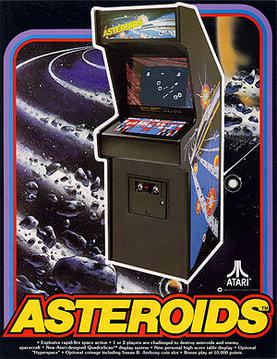
- Perfect clarity: every rule is readable within seconds, yet mastery can take years.
- Motion as tension: inertia and rotation make every mistake feel physical and memorable.
- Arcade purity: no waste, no padding, just score-chasing survival in its cleanest form.
- Historic weight: it became one of the defining hits of the golden age of arcade games.
“A triangle, some rocks, a black void — and total immortality.”
Asteroids proves how little a great game actually needs when the design is this precise.
The Arcade Game Reduced to Its Purest Form
Asteroids is one of the clearest examples of timeless arcade design because it removes nearly everything non-essential and leaves behind only movement, risk, and score pressure. You pilot a tiny ship in open space, but that simplicity is deceptive: momentum turns navigation into judgment, wraparound space turns the screen into a trap, and every broken rock becomes a more dangerous version of itself. The result is a game that feels immediate on first contact and infinitely sharpenable once the player understands its rhythm.
Game Data
| Title | Asteroids |
| Release Year | 1979 |
| Developer | Atari, Inc. |
| Publisher | Atari, Inc. |
| Platform | Arcade |
| Genre | Multidirectional shooter |
| Players | 1–2 players (alternating turns) |
| Display Type | Vector monitor |
| Core Loop | Rotate, thrust, fire, evade, survive, outscore |
Inertia-based movement, 360-degree aiming, wraparound space, asteroid splitting, saucer duels, and escalating score pressure.
There is almost no narrative framing at all — only a lone ship, deadly rocks, hostile saucers, and the endless logic of survival.
Asteroids turns inertia into drama. The ship does not stop on command like in later arcade shooters; it drifts, commits, and forces the player to think ahead.
Review / Why It Still Plays So Well
Asteroids still works instantly because its objectives are obvious and its danger is immediate. Rocks drift toward you. The ship rotates instead of snapping into direction. One button fires. One button thrusts. Within moments, the player understands the basics — and then almost immediately learns that understanding the basics is not the same thing as surviving.
WHY THE MOVEMENT MATTERSThe defining genius of Asteroids is that motion has consequences. The ship carries momentum. It glides when you stop thrusting. That means movement is never purely corrective. Every action leaves a trace. Every bad angle has to be lived with for a moment. This gives the game a sense of physicality that still feels special. The ship is not a cursor. It is a commitment.
SPACE AS A TRAPWraparound space is one of the game’s smartest ideas. Leaving one side of the screen means reappearing on the other, which turns the playfield into a closed system. There is no true escape route. Asteroids can drift in from behind. Saucers can turn space into an ambush. The arena feels clean, but never safe. That tension is a big part of why the game remains gripping.
THE SPLITTING-ROCK RHYTHMThe asteroids themselves are an elegant escalation system. Shooting one threat creates two smaller threats, then smaller threats again. Destruction and danger are tied together. That means success is always mixed with additional pressure. Asteroids does not merely ask, “Can you aim?” It asks, “Can you control what happens after you aim?”
FINAL VERDICTAsteroids is one of those masterpieces that becomes more impressive the longer you think about it. It is visually minimal, mechanically transparent, endlessly replayable, and historically enormous. More than almost any other early arcade game, it proves that timelessness does not come from scale. It comes from perfect relationships between rules.
Why Historically Important
Asteroids was one of the defining hits of the golden age of arcade games and became Atari’s most successful arcade release. That alone would make it historically important, but its influence reaches much further than sales. It crystallized a kind of arcade philosophy: instantly readable rules, unusually high skill ceilings, and a design structure built around replay rather than conclusion.
It also helped cement vector graphics as more than a novelty. The luminous line-work, clean geometry, and precision targeting gave the game an aesthetic identity unlike many raster-based contemporaries. Asteroids looked sharp, fast, and modern in 1979, and it still carries a visual authority because there is so little clutter between the player and the rule set.
Beyond presentation, the game influenced the design language of countless shooters and action games. Momentum, screen-wrap danger, escalating enemy fragmentation, and pure score tension all echo far beyond Asteroids itself. It is not just a famous old arcade game. It is a structural reference point for how action games can remain compelling without needing excess.
Timeline / Key Milestones
Asteroids releases in arcades and quickly becomes one of Atari’s most important coin-op successes.
The game rises to the top of U.S. arcade charts and becomes a defining machine of the golden age.
Atari 2600 and other home-system versions help carry Asteroids from arcade phenomenon into living-room brand recognition.
The direct arcade follow-up arrives, refining the formula and pushing expert players into a more aggressive, difficult variant.
Asteroids is inducted into the World Video Game Hall of Fame, confirming its place among the medium’s foundational works.
Where to Play / Collect Today
Modern Atari collections
The easiest current route is usually through Atari retro compilations and classic collections, where Asteroids is preserved as a pillar of the brand’s legacy.
MODERN OPTIONOriginal vector arcade cabinet
On authentic hardware, the glowing vector monitor and cabinet controls give Asteroids a physical intensity that no later version fully duplicates.
COLLECTOR ROUTEAtari 2600 version
The 2600 port is historically important in its own right and shows how one of arcade gaming’s great abstractions was translated for home play.
SEE VERSION