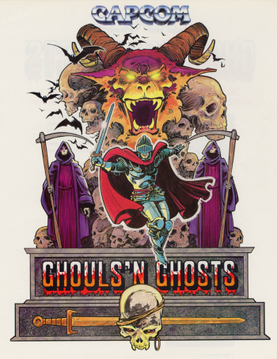
- Instant identity: a medieval horror platformer with a mood no one forgets after the first graveyard minute.
- Pure pressure: Arthur’s two-hit armor system makes every jump, spawn, and weapon choice feel painfully important.
- Cruel brilliance: much of the game is memorization, but that very harshness helped define a whole school of “hard but iconic” action design.
- Historic weight: it became one of Capcom’s signature early hits and one of the most notorious challenge games of the 1980s.
“One of gaming’s great cruelty machines.”
Not elegant in the same way as Mario — unforgettable because it weaponizes panic, commitment, and humiliation.
The Beautiful Nightmare of Early Capcom
Ghosts ’n Goblins is one of those foundational action games that never stopped being a threat. You do not gently “tour” it. You survive it in fragments. The cemetery, the red demons, the ladders, the armor shattering away until Arthur runs around in boxer shorts — it all lands with unusual force even now. Its controls are readable, but its world is hostile, and that contrast is exactly what made it legendary. It is less about comfort than nerve, less about smooth empowerment than learning to move through a machine that wants you to panic.
Game Data
| Title | Ghosts ’n Goblins |
| Release Year | 1985 |
| Developer | Capcom |
| Publisher | Capcom |
| Original Platform | Arcade |
| Major Early Ports | NES / Famicom, Commodore 64, ZX Spectrum, Amstrad CPC, Amiga, Atari ST |
| Genre | Run-and-gun platformer |
| Players | 1–2 players (alternating) |
| Original Format | Arcade board, later cartridges and computer releases |
| Core Loop | Run, jump, throw, memorize, endure, repeat |
Two-hit survival, weapon juggling, enemy-spawn memorization, committed jump arcs, checkpoint recovery, and boss-route discipline.
Sir Arthur charges into the Demon Realm to rescue Princess Prin-Prin after she is abducted by Astaroth and his monstrous army.
Clearing the game once is not enough: after defeating the final boss, the player must replay the entire quest on a harder loop to reach the genuine ending.
Review / Why It Still Hurts — and Still Works
The opening stretch tells you almost everything. The graveyard looks manageable for a moment, then zombies burst from the earth, projectiles crowd the air, and suddenly Arthur’s armor is gone. One more hit and you are dead. That fast transition from control to vulnerability is the heart of the game. Ghosts ’n Goblins is not merely difficult because it is old. It is difficult because it was intentionally built to put the player under immediate psychological pressure.
THE ARMOR SYSTEMArthur’s two-hit durability is one of the game’s great design images. The first hit is a spectacle: armor explodes and leaves him scrambling in his underwear. The second means death. That single idea makes every threat sharper. It also creates a memorable visual vocabulary that became inseparable from the series. Very few old arcade systems communicate danger so clearly, so quickly, and so humiliatingly.
COMMITTED MOVEMENT, COMMITTED CONSEQUENCESThe jump physics are not sloppy, but they are committed. Once you launch, you cannot improvise much in the air. That means many failures feel pre-written the moment you make a bad decision. Modern players may call that stiff; classic players would call it demanding. Either way, the result is the same: Ghosts ’n Goblins forces planning. You do not dance through it. You choose, and then live with the choice.
WEAPONS, MEMORIZATION, AND THE GAME’S CRUEL STREAKThe weapon system gives the adventure more texture than a simple one-button action game might suggest. Lances are reliable, daggers are fast, other tools can be useful or disastrous depending on the encounter. Add checkpoints, enemy spawn knowledge, awkward terrain, and bosses that strongly favor certain weapon choices, and the game becomes a study in route learning. Sometimes that feels exhilarating. Sometimes it feels openly mean. Both are part of its identity.
THE SECOND LOOPThe most infamous decision is the fake-out ending structure. Reaching the apparent end is not the end. The game sends you back through the whole nightmare again before allowing the real conclusion. That twist is legendary partly because it is outrageous, and partly because it perfectly reveals the arcade mindset underneath the whole design: mastery must be proven, not assumed.
FINAL VERDICTGhosts ’n Goblins is not as universally “pleasant” to revisit as some 1980s classics, and that is fine. Its value is not comfort. Its value is force. The sound, the monster design, the weapon tension, the fragility of Arthur, and the sheer audacity of its difficulty all help explain why it still occupies such a large place in retro memory. You may not love every minute of it. You will remember it.
Why Historically Important
Ghosts ’n Goblins helped define a particular kind of action-platform game: punishing but instantly legible, theatrical in its horror-fantasy presentation, and deeply tuned for repeat play. It was not just “hard.” It was recognizably, stylishly hard. That distinction matters. The game created a clear personality around challenge, which is a big reason it stayed visible across arcade culture, console ports, and decades of retrospective discussion.
It also mattered to Capcom’s rise. In the mid-1980s, the company was building a reputation for sharp arcade action, and Ghosts ’n Goblins became one of its signature names. Arthur, Astaroth, the graveyard opening, and the boxer-shorts humiliation state all turned into durable pieces of gaming iconography. The game was ported everywhere because people wanted the ordeal at home too.
Today, its legacy survives in several directions: in hard action-platformers, in discussions of “arcade cruelty,” in the continued life of the Ghosts ’n Goblins series, and in the way players still use it as shorthand for uncompromising retro challenge. It is a classic not because it is clean or easy, but because its identity is so complete.
Timeline / Key Milestones
Ghosts ’n Goblins launches in arcades and immediately earns a reputation for savage difficulty, horror atmosphere, and unforgettable visual identity.
The game spreads across Famicom / NES and a wide range of home computer formats, turning an arcade ordeal into a cross-platform phenomenon.
Its reputation hardens into legend: one of the titles people cite when talking about the brutality of classic action design.
Ghouls ’n Ghosts and Super Ghouls ’n Ghosts extend Arthur’s nightmare into one of Capcom’s most durable action lineages.
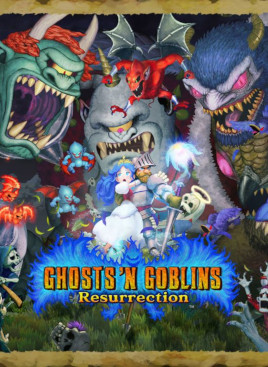
Capcom reissues the arcade original through Capcom Arcade Stadium and celebrates the franchise with Ghosts ’n Goblins Resurrection.
Where to Play / Collect Today
Capcom Arcade Stadium
The easiest official path to the arcade original today is through Capcom Arcade Stadium, where Ghosts ’n Goblins is sold as a standalone arcade pack on modern digital platforms.
MODERN OPTIONArcade / NES / classic computer hardware
For full period atmosphere, original arcade cabinets, Famicom / NES cartridges, and early home-computer ports give the game the rough edges that shaped its reputation.
COLLECTOR ROUTEGhosts ’n Goblins Resurrection
It is not the same game, but it is the clearest modern companion piece — a contemporary rethinking of Arthur’s challenge for players who want the series in current form.
SEE MODERN TAKE