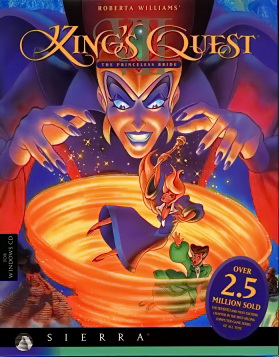
- Series high point candidate: many players see VI as the most complete balance of story, puzzles, tone, and audiovisual ambition.
- Alexander finally clicks: he becomes a true lead here, not just a rescued prince or family footnote.
- Multiple endings: short path versus fuller path gives the adventure unusual replay texture and consequence.
- World design leap: the Land of the Green Isles turns the series into a richer and more literary fantasy mosaic.
“The most romantic, literary, and structurally satisfying King’s Quest.”
Not just a beautiful Sierra adventure — one of the clearest cases where the series’ writing, art, and puzzle design all peak together.
The Green Isles Masterpiece
King’s Quest VI is the kind of sequel that feels like a culmination rather than just a continuation. It takes the series’ fairy-tale identity and gives it stronger writing, a more coherent emotional core, and a setting large enough to feel mythic without losing intimacy. Alexander’s search for Cassima becomes a romantic quest, an island odyssey, and a puzzle-driven fantasy travelogue all at once — which is why VI still feels richer than so many of its peers.
Game Data
| Title | King’s Quest VI: Heir Today, Gone Tomorrow |
| Release Year | 1992 |
| Developer | Sierra On-Line |
| Amiga Version | Revolution Software |
| Publisher | Sierra On-Line |
| Writers / Designers | Jane Jensen, Roberta Williams |
| Director(s) | Jane Jensen, William D. Skirvin, Roberta Williams |
| Platform(s) | MS-DOS, Windows, Macintosh, Amiga |
| Genre | Graphic adventure / point-and-click adventure |
| Players | 1 player |
| Engine | SCI1.1 |
| Original Formats | Floppy release, later enhanced CD-ROM edition |
| Protagonist | Prince Alexander of Daventry |
| Core Loop | Explore islands, solve puzzles, gather proofs, rescue Cassima, choose your path |
Island-based exploration, inventory logic, optional problem-solving paths, environmental puzzle chains, hidden narrative texture, and ending variations based on player choices.
Haunted by his memory of Princess Cassima, Alexander sails toward the Land of the Green Isles, is shipwrecked on the Isle of the Crown, and uncovers a plot involving the vizier Abdul Alhazred, royal murder, forced marriage, and a kingdom in peril.
VI is the King’s Quest that most clearly opens the series to branching outcome logic: different routes and different choices can produce different endings, including the game’s most rewarding “full” resolution.
Review / Why So Many Players Call It the Best
Earlier King’s Quest games establish Alexander as part of the royal family story, but VI is where he truly earns leading-man status. He is less archetypal than Graham and more romantic, more uncertain, and in some ways more human. That matters because the game is not simply about restoring order — it is about desire, pursuit, and proving oneself worthy inside a world built around stories, symbols, and tests.
THE WRITING DIFFERENCEThe biggest reason VI still stands out is writing quality. The Land of the Green Isles is not just a map with themed zones; it feels authored. The Arabian Nights echoes of the Isle of the Crown, the Alice-style surrealism of Wonder, the mythic gravity of the Sacred Mountain, and the Beauty-and-the-Beast tension of the Beast’s domain all feel intentionally chosen rather than randomly decorative. The game reads like a fantasy anthology held together by one urgent romantic rescue.
PUZZLES WITH MORE PAYOFFKing’s Quest VI still contains danger, dead ends, and classic Sierra sharp edges, but it is far more generous in how it rewards observation. The puzzle design feels more reasoned and more narratively integrated than some earlier entries. Better still, the branching outcome structure means the game lets you finish one way and then quietly shows you there was a fuller, richer, more complete path waiting beneath the surface.
THE CD-ROM ERA BOOSTVI is also one of those games that visibly benefits from its era’s hardware ambitions. The enhanced CD-ROM edition — with fuller speech, a pre-rendered introduction, and a stronger audiovisual frame — helps the adventure feel more theatrical and more “prestige Sierra” than ever. It is not modern cinematic storytelling, but for its moment it is strikingly confident.
FINAL VERDICTKing’s Quest VI is the rare middle-late series entry that does not merely refine the formula but deepens it. It keeps the fairy-tale inheritance intact while adding better writing, stronger world-building, more emotionally readable stakes, and a structural cleverness the series had not fully reached before. If there is a single King’s Quest that most cleanly justifies the legend, this is it.
Why Historically Important
King’s Quest VI matters because it represents one of Sierra’s clearest artistic maturation points. The series had already been important, already been commercially strong, and already become a pillar of the graphic-adventure era. But VI adds something rarer: it makes the writing, structure, and emotional motivation feel as central as the spectacle.
It is also historically important because it shows classic adventure design becoming more flexible. The game does not fully abandon Sierra danger, but it begins to reward players with route variation, layered endings, and a more readable relationship between story choices and narrative payoff. That makes it an important bridge between stricter 1980s adventure logic and the more character-driven adventure design that would define many 1990s standouts.
Finally, VI is one of the key examples of the CD-ROM transition strengthening an adventure rather than just decorating it. Voice work, audiovisual polish, and a more ambitious introduction all helped frame the game as a premium fantasy event. That combination of literary design, mechanical flexibility, and multimedia confidence is why it remains such a central archive piece.
Timeline / Key Milestones
King’s Quest VI releases as Sierra’s sixth mainline entry, placing Prince Alexander at the center of a larger, more literary fantasy quest.
The series leaves the old Daventry-centric comfort zone and embraces a multi-island structure shaped by myth, folklore, and storybook traditions.
VI becomes the first King’s Quest to make different successful endings a signature design feature rather than a minor alternate flourish.
The CD-ROM release adds fuller speech, a pre-rendered introduction, and a more theatrical presentation that helped define the game’s prestige reputation.
Re-releases and compatibility wrappers keep VI available for modern retro players, helping preserve what many regard as the series’ artistic peak.
It survives not just as a beloved entry, but as the game most often named when players ask which single classic King’s Quest still best represents the series.
Where to Play / Collect Today
GOG’s King’s Quest 4+5+6 package
The easiest modern route is the GOG bundle, which keeps VI commercially available alongside IV and V and makes direct series comparison especially convenient.
MODERN OPTIONOriginal CD-ROM edition
For many players, the enhanced CD-ROM version is the ideal way to experience VI thanks to its fuller speech, stronger introduction, and more premium presentation.
BEST VERSIONBig-box Sierra release
The original boxed editions remain a prime collector path for fans who want manuals, disks or CD media, and the full Sierra-era fantasy packaging context.
COLLECTOR ROUTE