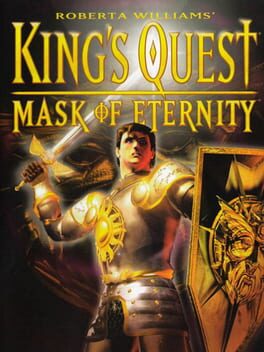
- Series rupture: this is the official King’s Quest that breaks hardest with the old formula.
- 3D experiment: swords, ranged combat, camera movement, potions, and real-time action redefine the rhythm.
- Not pure Sierra comfort food: it can feel clunky and uneven, but it is never boring as a historical object.
- Archive importance: it is the last official pre-reboot mainline entry and one of Sierra’s clearest late-1990s genre pivots.
“The strangest official King’s Quest — and one of the most revealing.”
Less a graceful continuation than a fascinating collision between classic adventure heritage and late-1990s 3D ambition.
The Great King’s Quest Detour
Mask of Eternity is one of the most important “difficult” pages in any serious King’s Quest archive because it forces you to decide what the series actually is. Is King’s Quest defined by Graham, by fairy-tale tone, by inventory puzzle logic, by cursor-based exploration, or by Roberta Williams’ broader instinct for fantasy questing? This game answers that question by blowing up the formula on purpose. You play not as Graham or one of his children, but as Connor of Daventry — a new hero thrown into a world fractured by the destruction of the Mask of Eternity.
Game Data
| Title | King’s Quest VIII: Mask of Eternity |
| Release Year | 1998 |
| Developer | Sierra Studios / Sierra On-Line |
| Publisher | Sierra Studios / Sierra On-Line |
| Platform | Microsoft Windows |
| Genre | Action-adventure / adventure hybrid |
| Players | 1 player |
| Original Format | CD-ROM |
| Protagonist | Connor of Daventry |
| Core Loop | Explore, fight, solve, collect mask pieces, restore order |
Third-person 3D exploration, melee and ranged combat, potions and light progression systems, contextual interaction, environmental traversal, and classic-style puzzle gates.
The evil Lucreto shatters the Mask of Eternity, turning much of the world to stone. Protected by a fallen mask fragment, Connor becomes the unlikely champion charged with restoring the mask and saving Daventry.
This is the first and only mainline King’s Quest led by someone outside Graham’s family — and the first main entry to go fully 3D.
Review / Why It Still Divides Players
The first hours of Mask of Eternity feel like a deliberate act of defiance. The series that once trained players to think in terms of verbs, fairy-tale logic, and carefully staged scenic screens now asks them to move through real-time 3D spaces, swing weapons, manage healing supplies, and navigate an action-adventure rhythm. That tonal and mechanical shock is the main reason the game remains controversial. People do not simply react to how it plays; they react to what it replaced.
WHERE IT WORKSYet the game has more going for it than its reputation often suggests. The dark, mythic atmosphere is strong. Connor is not as iconic as Graham, but he works as a grounded fantasy protagonist. The world has weight. The ruined, cursed, and fragmented feel of the realms gives the adventure a colder mood than earlier King’s Quest entries, and that distinct tone helps the game stand on its own rather than feeling like a weak imitation of the past.
WHERE IT STUMBLESThe friction comes from execution. The camera can feel awkward. The combat is serviceable rather than elegant. Some encounters and movement sequences date the game more harshly than a static 2D Sierra scene ever could. And because the series’ classic puzzle density is reduced, players coming in for pure old-school adventure design may feel that the game is spending too much time being merely competent at action instead of brilliant at riddles.
WHAT MAKES IT WORTH RETURNING TOThe reason to play Mask of Eternity today is not because it secretly outclasses the earlier classics. It is because it captures a rare historical moment: a legendary adventure series trying to reinvent itself at the exact point when PC design priorities were shifting under its feet. That makes every compromise and every successful idea more visible. You can watch Sierra thinking in real time about how to survive the 3D era.
FINAL VERDICTKing’s Quest VIII is flawed, but not disposable. It is the official black sheep, the last Sierra-era chapter, the 3D gamble, the Connor experiment, the game that pushed the franchise toward action and paid a price for it. That combination makes it not just playable, but historically indispensable.
Why Historically Important
Mask of Eternity matters because it shows exactly what happened when one of the foundational adventure franchises collided with the late-1990s demand for full 3D worlds, direct character movement, and a broader action vocabulary. It is not just a sequel. It is Sierra’s visible attempt to retool what a King’s Quest game could be.
It is also historically important because it breaks multiple series rules at once. Connor is not Graham. The game does not rely on painted 2D scenes. Combat is not a side flourish; it is part of the core structure. Even the packaging deemphasized the familiar numbering in a way that hinted at how unsure the series itself had become about continuity versus reinvention.
Finally, its importance is magnified by where it sits in the timeline. This was the last official pre-reboot mainline King’s Quest entry, meaning it became the closing statement of the Sierra era whether fans wanted that or not. That alone makes it a crucial archive piece — not because it is the perfect finale, but because it reveals the pressures, ambitions, and anxieties of its moment better than a safer sequel ever could.
Timeline / Key Milestones
King’s Quest: Mask of Eternity releases for Windows as the eighth official game in the series and the franchise’s first full leap into 3D.
The series introduces Connor of Daventry as its hero, making Mask of Eternity the only mainline King’s Quest led by someone outside Graham’s family.
Players and critics split over the action focus, camera, combat, and darker tone. Some admire its ambition; others see it as the point where King’s Quest stopped feeling like itself.
The game returns commercially through GOG’s King’s Quest 7+8 package, preserving access to Sierra’s final pre-reboot chapter for modern retro-PC players.
The official King’s Quest reboot arrives after a long dormancy, turning Mask of Eternity into the clear endpoint of the original Sierra-era line.
It survives as the franchise’s most debated official entry — neither forgotten nor fully embraced, but impossible to remove from any honest King’s Quest history.
Where to Play / Explore Today
GOG’s King’s Quest 7+8 package
The cleanest modern route is GOG’s combined release, which keeps Mask of Eternity commercially available alongside The Princeless Bride for Windows-era compatibility setups.
MODERN OPTIONOriginal Windows big-box route
The original CD-ROM release remains the best collector path for players who want the late-1990s Sierra packaging, manual feel, and authentic hardware context.
COLLECTOR ROUTEPlay it against VII and the 2015 reboot
Mask of Eternity becomes much more interesting when treated as the bridge — or fracture line — between the cartoon warmth of VII and the later official reboot.
SEE CONTEXT