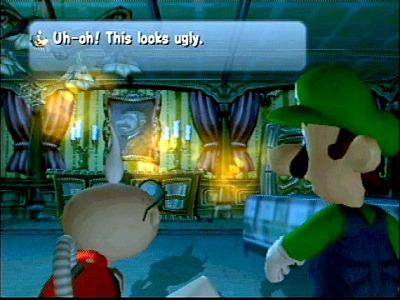
- Pure personality: Luigi’s fear animation, muttering, and hesitation give the whole game a rare charm.
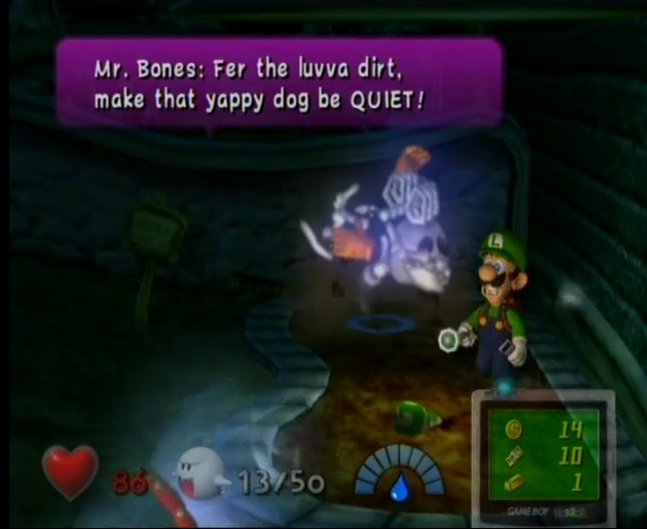
- Ghost-catching feel: flashlight stun plus Poltergust pullback still makes captures tense and satisfying.
- Mansion mood: the house feels intimate, strange, and memorable in a way many larger games never manage.
- Historical weight: it helped define early GameCube identity and proved Luigi could carry a major release.
“Short, stylish, spooky, and packed with character.”
Less a giant epic than a perfectly themed haunted-house adventure with one of Nintendo’s most endearing lead performances.
The GameCube’s First Big Mood Piece
Luigi’s Mansion stands out because it does not try to overwhelm you with scale. Instead, it wins through tone, animation, and focus. You enter one mansion, move room by room, study its tricks, and gradually turn panic into confidence. That small scope is part of its strength: the house becomes familiar, the ghost routines become readable, and Luigi himself becomes one of Nintendo’s most lovable protagonists precisely because he is so obviously terrified.
Game Data
| Title | Luigi’s Mansion |
| Release Year | 2001 |
| Developer | Nintendo EAD |
| Publisher | Nintendo |
| Platform | Nintendo GameCube |
| Genre | Action-adventure / ghost-hunting adventure |
| Players | 1 player |
| Original Format | MiniDVD-based GameCube disc |
| Series Role | First Luigi’s Mansion game |
| Core Loop | Explore, stun, vacuum, solve, unlock |
Mansion exploration, key-gated progression, environmental puzzle-solving, portrait ghost encounters, Boo hunting, and treasure collection.
Luigi wins a mansion he never entered a contest for, arrives expecting luxury, and instead finds a ghost-infested trap. With Professor E. Gadd’s Poltergust 3000 and the Game Boy Horror, he must rescue Mario and survive the night.
The game introduced both Professor E. Gadd and King Boo, two characters who became lasting parts of Mario universe lore.
Review / Why It Still Feels So Fresh
Luigi’s Mansion makes a fantastic first impression because the entire experience is built around mood. The lighting is dramatic, the rooms are richly themed, and Luigi himself is a walking bundle of nerves. Even before you understand the full rhythm of catching ghosts, the game sells you on its identity: this is a spooky comedy, not survival horror, but it still wants you to feel tension when the lights go out and the furniture starts moving.
THE POLTERGUST LOOPThe core capture mechanic remains clever. You stun a ghost with light, latch on with the Poltergust 3000, and then wrestle against its attempts to break free. That little tug-of-war gives even routine encounters some physicality. It is a small system, but it feels good in the hands, and Nintendo wisely builds the entire game around variations of it.
WHY THE MANSION WORKSThe mansion is the true star. Rooms have identity. Corridors feel different at night than they do once you know them. Boss-like portrait ghosts turn individual chambers into tiny set pieces, and the slow unlocking of wings and floors gives the adventure a satisfying sense of spatial mastery. By the end, you know the place in a way that makes it feel more real than many much larger game spaces.
ITS BIGGEST LIMITATIONThe most common criticism remains true: Luigi’s Mansion is short. It is not the kind of giant flagship adventure some players expected from a new Nintendo console. But that brevity also keeps it replayable and sharp. There is very little wasted motion here. It ends before its gimmicks go stale, and that is part of why the game still feels so clean.
FINAL VERDICTLuigi’s Mansion is one of Nintendo’s most focused early-2000s successes: not enormous, not overloaded, just expertly themed and consistently charming. It gave Luigi a true starring role, gave the GameCube an identity piece, and delivered a ghost-hunting loop that still feels playful and distinct more than two decades later.
Why Historically Important
Luigi’s Mansion mattered immediately because it was one of the GameCube’s defining early showcases. It demonstrated dynamic lighting, animation expressiveness, and environmental mood in a way that made the hardware feel modern and characterful rather than merely powerful. Even players who wanted a giant Mario epic ended up remembering Luigi’s Mansion because it felt so specific.
It also changed Luigi’s status. Before this, Luigi was often secondary comic support. Here he became the emotional center of an entire game: frightened, reluctant, funny, and yet still heroic. That version of Luigi stuck. The series effectively turned his cowardice into a design strength.
Finally, the game introduced enduring Mario-universe elements such as Professor E. Gadd and King Boo while establishing the haunted-house identity that carried into sequels, remakes, and spin-off references for years afterward. Luigi’s Mansion is not just a good launch title — it is the beginning of a real Nintendo sub-series with its own tone.
Timeline / Key Milestones
Luigi’s Mansion begins life as one of the most striking early demonstrations of GameCube hardware and its character-animation potential.
The finished game arrives as a major early release for the system and becomes one of the console’s defining opening statements.
European and Australian players get the game during the next wave of GameCube expansion, helping cement its cult status outside North America and Japan.
Nintendo revisits the original with a handheld remake, bringing the mansion to a new audience with updated visuals and added features.
The original version joins the Nintendo GameCube – Nintendo Classics library for Nintendo Switch 2, giving the 2001 release a modern official route again.
It is still the game that defines the tone, humor, and emotional appeal of the Luigi’s Mansion series.
Where to Play / Collect Today
Switch 2 Nintendo Classics route
The cleanest current official route is the Nintendo GameCube – Nintendo Classics library on Switch 2 with a Nintendo Switch Online + Expansion Pack membership.
MODERN OPTIONOriginal GameCube / compatible Wii
For the authentic early-2000s feel, the original disc on GameCube or a backward-compatible Wii still gives the best period-correct mood and controller feel.
COLLECTOR ROUTENintendo 3DS version
The 2018 3DS remake is the easiest alternate way to revisit the game if you want portable play and a refreshed version of the same mansion crawl.
SEE REMAKE