- Push-your-luck tension: every completed card asks the same question — stop safely, or gamble the whole round.
- Social wordplay: the challenge system means spelling knowledge and table politics matter as much as speed.
- Magazine-era charm: it feels like a smart home-computer game built for curious families and clever friends.
- Archive value: it captures the type-in and cover-disk culture that made late-1980s Atari computing special.
“Crossword nerves, dice luck, and one more risky turn.”
Tiny in scale, but a perfect example of how much personality the Atari magazine scene could squeeze from a simple idea.
A Puzzle Game Built for the Atari Magazine Era
The Nerve Game is the kind of title that instantly tells you what kind of computer culture produced it. It is not a mascot platformer, not an arcade conversion, and not a sprawling adventure. It is a sharp, timer-based word game built for players who enjoyed typing in programs, sharing disks, arguing over spelling, and squeezing more tension out of a simple ruleset than anyone expected. That is exactly where its charm lives.
Game Data
| Title | The Nerve Game |
| Release Year | 1989 |
| Creator | Jason Strautman |
| Publisher | Antic / Antic Publishing |
| Platform | Atari 8-bit computers |
| Genre | Timed word / puzzle game |
| Players | 1–8 players |
| Original Format | BASIC listing / magazine disk |
| Hardware Notes | 48K memory and disk drive |
| Core Loop | Roll letters, fill cards, bank progress, or risk another round |
Dice-generated letters, crossword-style card completion, timed turns, re-roll freedom, challenge-based validation, and a constant risk-versus-security decision.
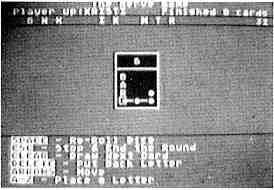
Every player tries to complete the same eight puzzle cards in as few turns as possible, using letter rolls to fill word shapes before the clock expires.
The game’s signature mechanic is not spelling alone — it is the moment after a finished card when the player must decide whether to stop safely or press onward and risk losing the entire round.
Review / Why It Still Has Bite
The setup is wonderfully direct. You are given letters, a timed turn, and a card full of dotted spaces waiting to become valid words. At first glance, it feels like a home-computer word exercise. Then the risk layer appears. Finishing one card is good. Finishing two in one run is better. But fail before you bank them, and the whole round evaporates. That single mechanic gives the game its title, its identity, and most of its personality.
WHY THE DESIGN WORKSThe Nerve Game understands that tension does not require spectacle. It only needs pressure and choice. The timer supplies pressure. The decision to continue or stop supplies choice. Because the letters are rerolled and the cards are crossword-style rather than clue-driven, the experience feels halfway between a word game, a party contest, and a tiny strategy challenge. That is a surprisingly durable mix.
WHAT DATES ITLike many magazine-era titles, it is austere. The interface is utilitarian, the computer does not validate every word automatically, and some of the fun depends on human players policing each other honestly. For modern players that can feel rough, even inconvenient. But that roughness is also part of the game’s period character. It assumes a real room, real people, and a little bit of friendly argument.
WHAT STILL FEELS FRESHThe best thing about The Nerve Game is that its core decision is timeless. Bank progress or risk more. That question works in card games, roguelikes, quiz shows, and tabletop sessions because it always produces emotion. Here, it is attached to language skill and puzzle clarity, which makes the result feel unusual even now.
FINAL VERDICTThe Nerve Game is not a blockbuster lost masterpiece. It is something more specific and, in some ways, more valuable: a genuinely clever small-format computer game whose personality comes from the exact culture that made it. As an archive piece and as a playable idea, it still absolutely works.
Why Historically Important
The Nerve Game matters because it belongs to a part of gaming history that often gets overshadowed by cartridges, arcades, and big publishers: the magazine-software ecosystem. In that world, a good idea could travel through a printed listing, a disk supplement, or a cover-mounted archive artifact. Games like this were not merely products. They were also invitations to participate in computing culture.
It also shows how much design mileage could be pulled from limited means. There are no cinematic tricks here, no licensed imagery, and no expensive production values. What survives is a ruleset, a timer, a set of word cards, and a really strong risk mechanic. That economy is part of why magazine-era software deserves preservation: it often exposes game design more nakedly than commercial blockbusters do.
On the Atari side, The Nerve Game is a reminder that the platform’s late-1980s life was still full of curiosity and invention. Even as mainstream attention moved elsewhere, the Atari 8-bit scene kept producing clever utilities, experiments, and games for people who still loved the machine. This title is one of those small but vivid traces.
Timeline / Key Milestones
The Nerve Game appears as Antic’s Game of the Month in the December 1989 issue, introducing it to Atari 8-bit readers as a BASIC word-and-timer challenge.
The game also becomes part of the Antic disk ecosystem, tying it directly to the practical magazine-software distribution culture of the time.
Like many small Atari magazine titles, it slips into niche archive status rather than broad commercial memory.
The full Antic issue is preserved online, helping keep the original article and surrounding magazine context accessible.
The Nerve Game survives as a small but telling example of Atari word-game design and the home-computer magazine scene.
Where to Play / Collect Today
Original Atari 8-bit setup
The most historically faithful way to experience The Nerve Game is on original Atari 8-bit hardware with the preserved magazine disk or typed-in BASIC program.
ORIGINAL ROUTEMagazine scans and preservation
The Antic issue, article, and associated archive materials are the most important surviving way to study the game today, even if you are mainly interested in its history.
SEE ARCHIVEAntic issue / disk collecting
For collectors, the game is most compelling as part of the broader Antic ecosystem — issue cover, disk label, and Atari magazine history all matter here.
COLLECTOR ROUTE