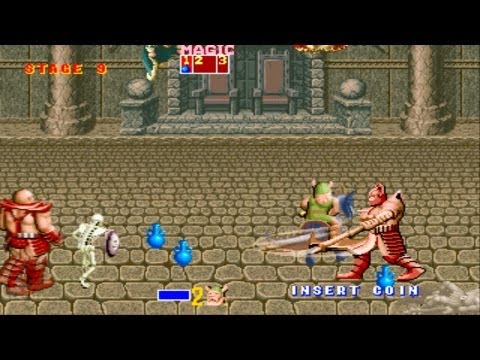
Altered Beast
Sega’s grave-rising arcade myth: oversized sprites, Greek-horror spectacle, transformation mechanics, and one of the most iconic opening voice lines in gaming history. A game that helped define Sega’s early arcade identity and later became a symbolic face of the Genesis launch era.
Why it still matters
- Transformation fantasy: the shift from fragile human fighter to beast-form powerhouse remains instantly memorable.
- Arcade theater: giant sprites, voice samples, and boss reveals made it feel bigger than many of its peers in 1988.
- Sega symbolism: it became an early Genesis pack-in symbol and tied itself directly to Sega’s 16-bit identity.
- Cultural imprint: “Rise from your grave” became one of retro gaming’s most quoted openings.
“A mythological arcade flex — loud, strange, and unforgettable.”
Altered Beast is not beloved because it is subtle. It is beloved because it announces itself like thunder.
The Moment Sega Learned How to Enter a Room
Altered Beast is one of those games whose historical importance extends far beyond whether every part of it has aged gracefully. In pure mechanical terms, it is a tough, sometimes stiff, side-scrolling brawler with light platforming. But as a piece of arcade presence, it is enormous.
The resurrected centurion, the Greek graveyard setting, the white wolves dropping Spirit Balls, the swelling body transformations, the booming digitized voice — all of it combines into something closer to a ritualized arcade performance than a conventional action game.
At a glanceBest experienced as a loud, mythic, display-piece arcade game: part beat ’em up, part monster movie, part Sega manifesto.
Game Data
| Title | Altered Beast |
| Japanese Title | Jūōki |
| Release Year | 1988 |
| Developer | Team Shinobi |
| Publisher | Sega |
| Designer | Makoto Uchida |
| Artist | Rieko Kodama |
| Composer | Tohru Nakabayashi |
| Arcade Hardware | Sega System 16 |
| Genre | Side-scrolling beat ’em up |
| Players | 1–2 simultaneous |
| Core Loop | Fight, collect Spirit Balls, transform, defeat boss |
Gameplay pillars
Side-scrolling combat, timing-based punches and kicks, Spirit Ball collection, beast transformations, boss-form confrontations, and spectacle-driven progression.
Story
Zeus resurrects a Roman centurion and sends him through a mythic underworld journey to rescue Athena from Neff, the demonic ruler of the dead.
Most famous design fact
Collecting three Spirit Balls in a stage triggers one of gaming’s signature power fantasies: the hero mutates into a beast form before the boss encounter.
Review / Why Altered Beast Endured
The genius of Altered Beast is not that it welcomes the player gently. It does the opposite. It begins with resurrection, digitized command, and immediate threat.
The character rises, enemies close in, and the game tells you through pure presentation that this is not a quiet heroic quest. It is myth performed as arcade excess.
The transformation hookWhite wolves appear, Spirit Balls drop, the hero grows stronger, and the final pickup detonates into full transformation. That sequence gives every level a small dramatic arc: vulnerability, escalation, then temporary dominance.
Modern players will notice the friction. Altered Beast is not fast in the sleek modern sense, and its collision, jumping, and combat spacing can feel blunt compared with later beat ’em ups.
But context matters. The game was built to be a high-impact arcade attraction, not a long-form action epic. Its job was to impress, threaten, and consume coins through dramatic repetition.
Why it still landsGreek ruins, undead enemies, transformation bodies, monstrous boss reveals, and voice commands are not random decoration. They all serve the same promise: the player will become something bigger than human.
Final verdictAltered Beast is one of gaming’s great identity machines. It may not be Sega’s deepest action design, but it is one of Sega’s clearest early statements of style.
Why It Matters
Altered Beast matters historically because it helped define how Sega wanted to present itself at the end of the 1980s: aggressive, flashy, larger-than-life, and willing to foreground arcade spectacle over softness or polish.
It also became historically important through distribution, not just design. By serving as an early pack-in title for the Genesis / Mega Drive in major western markets, Altered Beast became one of the first experiences many players had with Sega’s 16-bit console identity.
Beyond sales and hardware history, the game’s cultural residue is unusual. “Rise from your grave” survived as one of those lines that escaped the cabinet and entered wider retro-gaming memory.
Why it mattered then
It showed off Sega’s arcade spectacle with giant sprites, digitized voice, and transformations that felt like an event.
Why it matters now
It remains a clear example of how a game can become historically important through identity, atmosphere, and platform symbolism.
What it changed
It helped cement Sega’s early image and gave the Genesis launch era one of its defining mythic, arcade-born showpieces.
Timeline / Key Milestones
Altered Beast launches in arcades and immediately stands out for its transformations, Greek-horror setting, and booming voice samples.
The game begins its move to home hardware, carrying Sega’s arcade style directly toward the 16-bit console era.
In North America, Altered Beast becomes strongly associated with the Genesis launch period and Sega’s arcade-power-at-home message.
“Rise from your grave” outlives the cabinet itself and becomes one of the most repeated voice lines in retro gaming culture.
Re-releases, compilations, and later sequel / reboot material keep Altered Beast visible as a persistent Sega legacy property.
It remains one of the most recognizable early Sega action games — not always the most refined, but absolutely one of the most emblematic.
The beast rose in arcades — but the flyer, Genesis box, cartridge, and Sega launch memory are the artifacts.
Altered Beast belongs in the collector lane because it connects Sega arcade spectacle, Genesis / Mega Drive launch history, transformation fantasy, mythological monster design, and one of retro gaming’s most quoted voice samples.
Where to Play / Collect Today
A Sega arcade icon with powerful collector nostalgia.
For collectors, Altered Beast is appealing because it bridges arcade spectacle, early Genesis / Mega Drive identity, Sega hardware history, mythic monster artwork, and the unforgettable memory of “Rise from your grave.”
Amazon notice: As an Amazon Associate I earn from qualifying purchases.
A curated access point for Altered Beast fans: Genesis cartridges, boxed Mega Drive versions, arcade flyers, manuals, Sega compilations, display pieces, and future collector-focused retro finds.
Shop Altered Beast finds
Prepared for original Altered Beast searches: Genesis cartridges, boxed Mega Drive copies, manuals, arcade flyers, cabinet material, and condition-focused collector listings.
- Best route for original physical finds
- Useful for box, manual, cartridge, and flyer comparison
- Affiliate URL can be inserted later
TODO: Replace this placeholder with the final eBay Partner Network URL.
Browse related retro items
Prepared for Amazon availability: Sega collections, Genesis nostalgia books, retro console accessories, display items, and broader Sega arcade history media.
- Useful for books, collections, and accessories
- Good route for broader Sega nostalgia browsing
- Affiliate URL can be inserted later
TODO: Replace this placeholder with the final Amazon Associates short link.
Curated Etsy picks coming soon
Planned for Sega-style retro prints, arcade display pieces, shelf objects, custom archive decor, and tasteful handmade items that match the 4NERDS museum aesthetic.
- Wall art and display-focused pieces
- Handmade and fan-crafted style items
- Added once the setup is approved and tested
Etsy affiliate integration will be added after the tracking setup is ready.