- Elegant upgrade: Arkanoid takes Breakout’s bare structure and makes it dramatically richer without losing readability.
- Power-up drama: lasers, wider paddle, slow ball, multi-ball, and catch control add decision-making instead of mere decoration.
- Arcade tension: every bounce matters, enemy movement disrupts rhythm, and late stages become tests of nerve and angle control.
- Historical force: this is one of the defining brick-breakers — the game that made the subgenre feel like a full arcade event again.
“Not just a better Breakout — a full rebirth of the form.”
Arkanoid does not merely polish a classic template. It gives it speed, style, danger, and identity.
The Arcade Game That Re-Energized Breakout
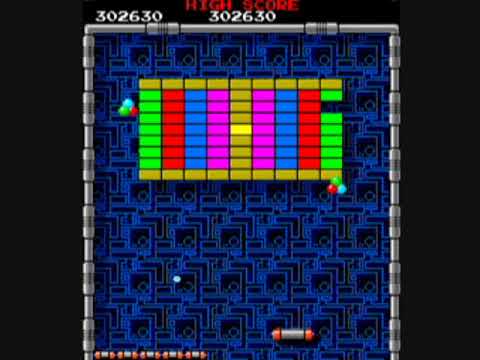
Arkanoid is one of the clearest examples of how an old concept can suddenly feel new again when the right developer touches it. On paper, the premise is still simple: keep the ball alive, break the wall, survive the stage. In motion, though, Taito transforms that simplicity into something faster, louder, and far more theatrical. The paddle becomes the Vaus. Capsules drop with temptation and risk. Enemies interrupt the clean geometry. The screen is brighter, the game is meaner, and the whole structure feels less like an abstract pastime and more like an actual arcade performance.
Game Data
| Title | Arkanoid |
| Release Year | 1986 |
| Developer | Taito |
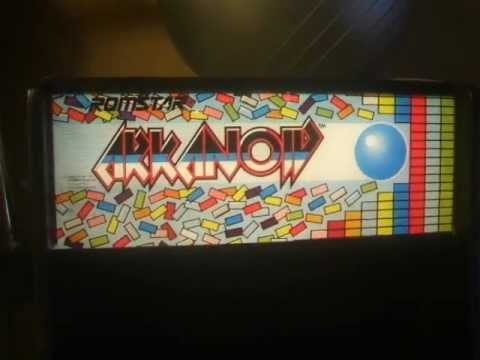
| Publisher | Taito (Japan), Romstar (North America arcade) |
| Platform | Arcade first; later NES, computers, and home systems |
| Genre | Block breaker / arcade action |
| Players | 1–2 players (alternating, depending on version) |
| Original Format | Arcade cabinet / conversion kit |
| Core Loop | Deflect, break, collect, survive, refine angles |
Paddle precision, angle control, falling capsule risk-reward, enemy disruption, stage pattern reading, and late-game recovery under pressure.
Humanity’s mothership Arkanoid is attacked, and the small craft Vaus is drawn into a strange region of floating blocks and hostile forces. The player breaks through this barrier field in search of survival and escape.
Arkanoid is the brick-breaker most people think of when they imagine the genre modernized: it popularized power-up capsules, stronger audiovisual identity, and a more dramatic arcade feel than many earlier imitators.
Review / Why Arkanoid Still Feels So Sharp
Arkanoid impresses quickly because its clarity is immediate. The paddle response is clean. The ball reads sharply against the field. The blocks are bright and spatially legible. Yet the game also feels more aggressive than the older brick-breakers it descends from. The moment capsules begin dropping and enemies begin interfering, the screen stops being a puzzle board and becomes a living threat field.
WHY THE POWER-UPS MATTERThe great trick of Arkanoid is that its bonuses are not simply gifts. They are temptations. To catch a falling capsule, you may need to break your ideal positioning. Go for the upgrade too greedily and you can lose control of the ball. That tension is brilliant because it means improvement is never passive. Every bonus asks a question: do you want immediate power, or do you want to preserve the current rhythm?
AUDIOVISUAL IDENTITYAnother reason Arkanoid towers above so many clones is presentation. The colorful wall formations, the sleek Vaus craft, the science-fiction framing, and the more expressive stage energy all make the game feel authored rather than generic. Breakout was elegant abstraction. Arkanoid is elegant abstraction with personality, fiction, and theatrical pressure layered over it.
THE LATE-GAME TESTAs Arkanoid progresses, it stops being about simple rally maintenance and starts becoming about survival under increasingly hostile geometry. Harder blocks, awkward angles, enemy units, and more chaotic recovery situations create the sensation that the screen is trying to unravel your concentration. That is where the game becomes truly memorable. It is no longer only reflexive — it is psychological.
FINAL VERDICTArkanoid remains one of the cleanest demonstrations of how to modernize a genre without bloating it. It keeps the fundamental readability of the original formula, but enriches it with power, risk, visual identity, and genuine arcade drama. It is not just one of the best block-breakers ever made. It is the block-breaker that made the genre feel important again.
Why Historically Important
Arkanoid is historically important because it did more than succeed — it redefined expectations for an entire subgenre that could easily have been dismissed as old and exhausted. Taito took the Breakout idea and reintroduced it as a modern arcade experience: richer mechanics, stronger pacing, more danger, more visual style, and more reasons for players to keep feeding coins.
Its additions were not random. Power-up capsules, multiple brick behaviors, enemy interruptions, and a distinct science-fiction wrapper made Arkanoid feel like a proper evolution rather than a mere clone. That is why the game cast such a long shadow. For many players and designers, “brick-breaker” after 1986 increasingly meant “something measured against Arkanoid.”
It also mattered commercially. The game became one of Taito’s major coin-op successes, topped key arcade charts in Japan, and performed strongly in other regions as well. Just as importantly, it spread widely through home ports and accessories like the Vaus controller, helping transfer arcade precision into living-room form. Arkanoid is a milestone in arcade refinement: proof that even the simplest ruleset can feel reborn when design intelligence and presentation move together.
Timeline / Key Milestones
Arkanoid releases in arcades and quickly separates itself from earlier brick-breakers through power-up capsules, stronger presentation, and more aggressive design.
The game rises to the top of major Japanese arcade rankings and becomes one of the year’s major coin-op stories.
Arkanoid spreads through home computer and console ports, with the NES version becoming especially notable thanks to the dedicated Vaus controller.
Taito follows up with a direct sequel, proving Arkanoid was not a one-off novelty but a durable arcade identity.
Arkanoid remains one of the most cited and replayed block-breakers ever made — still the benchmark many later entries are measured against.
Where to Play / Collect Today
Arcade archives / retro collections
The cleanest modern route is usually through retro reissues, arcade-history collections, or preservation-focused libraries that let the original design speak for itself.
MODERN OPTIONArcade cabinet or paddle controller
Arkanoid is one of those games that changes dramatically when played with the proper control style. A paddle or Vaus-style controller restores the intended precision.
COLLECTOR ROUTENES + Vaus controller
The NES version is historically important because it tried to preserve the arcade handling with its own dedicated controller — a rare and memorable accessory route.
SEE VERSION