AssaultNamco’s Rotating War Machine
A late-1980s arcade showpiece where twin-stick tank control, battlefield rotation, sprite-scaling spectacle, Rapid Rolls, Power Wheelies, and heavy mechanical commitment combine into one of Namco’s strangest and most fascinating System 2 statements.
Why this tank shooter still feels like a machine
- Mechanical identity: Assault is built around a tank that feels heavy, directional, and physically authored rather than merely abstract.
- Control depth: twin-stick movement, Rapid Roll, Power Wheelie, and lift-zone bombing give the game a rare tactical vocabulary.
- Hardware spectacle: the rotating and scaling battlefield is not decoration — it is central to how the game communicates movement and threat.
- Preservation value: it remains one of Namco’s most fascinating System 2-era experiments, even if it never became a mainstream household name.
“A tank game, a shooter, and a hardware flex in one cabinet.”
Assault feels like an arcade board proving that control, motion, and spectacle can become one physical language.
A Rotating Battlefield from Namco’s Experimental Peak
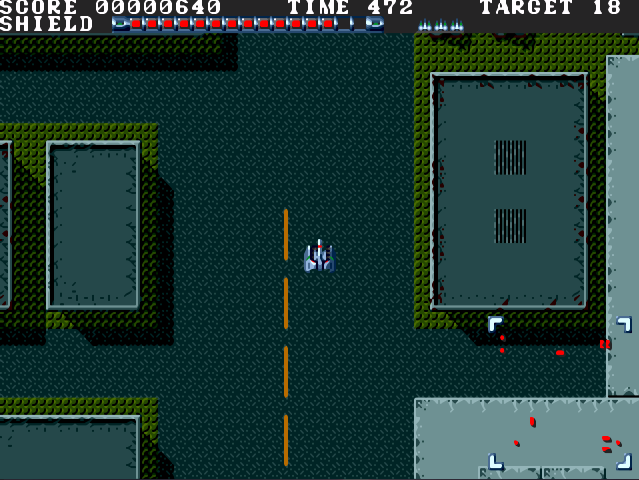
Assault is the kind of arcade game that announces its ambition immediately. The battlefield turns around the player. The vehicle feels like a real treaded assault platform. The controls ask for coordination instead of simple reaction. The screen is not just scrolling — it is rotating, tilting, scaling, and constantly reinforcing the idea that you are commanding a machine through hostile terrain.
That makes Assault more than a tank shooter. It is a physical arcade object with a control language all its own. Push both sticks, pivot, roll, launch grenades with a Power Wheelie, and use lift zones to bomb enemy structures from above. It can be awkward at first, but the awkwardness is meaningful: the game wants mastery to feel like learning a vehicle.
At a glanceBest experienced as a Namco System 2 showcase and a design study in how hardware effects, twin-stick input, and vehicle fantasy can form one coherent arcade identity.
Game Data
| Title | Assault |
| Arcade Release | 1988 |
| Developer | Namco |
| Publisher | Namco in Japan; Atari Games in North America |
| Platform | Arcade |
| Arcade Board | Namco System 2 |
| Genre | Multidirectional shooter / tank action |
| Players | 1–2 players |
| Controls | Dual-stick tank movement and attack controls |
| Core Loop | Advance, rotate, strafe, roll, bomb, destroy enemy bases, survive eleven-stage pressure |
Gameplay pillars
Twin-stick tread control, rotating terrain, sprite-scaling spectacle, Rapid Roll dodges, Power Wheelie grenade attacks, lift-zone aerial bombing, and careful approach to enemy strongholds.
Story
A native fighter pilots a powerful assault tank to reclaim a colonized world, turning the player’s vehicle into both a weapon of resistance and the center of the game’s machine fantasy.
Most famous design fact
Assault is remembered for making Namco System 2’s rotation and scaling features feel like core gameplay, not just a decorative technology demo.
Review / Why Assault Still Feels So Different
Assault can feel strange the first time you touch it. That is not a flaw. The control layout asks you to understand the vehicle rather than simply move an icon. Forward momentum, tank rotation, strafing, rolling, and bombing all require a kind of mechanical literacy.
Once it clicks, the game opens up. You stop reacting only to bullets and begin reading the whole battlefield: the angle of approach, the distance to the base, the timing of the roll, and whether a Power Wheelie is worth the commitment. It is action as machine handling.
Why the controls matterMany arcade shooters are about aiming and survival. Assault is also about body language. The tank has presence. It has mass. It has moves that must be learned. The result is a shooter where mastery feels less like twitch reaction and more like becoming fluent in a vehicle.
Assault’s scaling and rotation are not just late-1980s flash. They sell the fantasy that the tank is central and the world is moving around it. Lift zones, sudden shifts of view, bombing runs, and rotating terrain all turn hardware capability into play language.
Where it pushes backAssault is not frictionless. It asks for practice and can feel demanding before it becomes graceful. Players expecting a simpler top-down shooter may need a few rounds before the machine logic makes sense. But that friction is exactly what gives mastery its flavor.
Final verdictAssault deserves a larger reputation than it often gets. It is visually striking, mechanically original, and historically valuable without feeling like a museum piece only. It still has force because it still feels authored, physical, and strange.
Why It Matters
Assault matters because it sits at the intersection of arcade experimentation, control design, and hardware spectacle. In 1988, many games looked aggressive, but fewer made their visual technology feel this closely tied to the hands.
It also works as an early statement for Namco System 2. The board’s scaling and rotation features could have been merely flashy, but Assault uses them to define the player’s relationship to space. The tank is fixed, the world rotates, and the result is immediately distinct.
Historically, Assault also survives as a cult object rather than a universal mascot hit. That makes it valuable for an archive: it shows that arcade history was not only built by the biggest icons, but also by unusual machines that pushed control, cabinet presence, and display technology in new directions.
Why it mattered then
It showed that rotation and scaling hardware could create a distinctive play experience, not just a visual trick.
Why it matters now
It remains one of the clearest examples of an arcade game built around control expression and machine handling.
What it changed
It expanded the vocabulary of vehicle shooters by combining tank control, twin-stick input, aerial bombing, and dynamic terrain presentation.
Timeline / Key Milestones
Assault appears in Japanese arcades as one of Namco’s early System 2 showcase titles.
Atari Games handles the North American arcade release, giving the game a second collector identity through U.S. flyer and cabinet material.
A Japan-only updated version appears the same year, reworking the original into a variant that later becomes important for preservation.
Assault reaches PlayStation players through Namco Museum Vol. 4, where it survives as one of the compilation’s strongest deep cuts.
The game returns digitally in Japan, keeping its reputation alive outside original cabinet access.
Modern Arcade Archives releases help bring Assault and Assault Plus back into contemporary play conversations.
The rotating battlefield became the memory — but the flyer, cabinet, control panel, marquee, Namco Museum disc, Arcade Archives release, and Assault Plus variant are the artifacts.
Assault belongs in the collector lane because its identity is unusually physical: the dual-stick cabinet, yellow control panel, Atari Games flyer, Namco System 2 hardware context, and preservation releases all tell part of the story.
Where to Play / Collect Today
Collecting Assault means collecting an arcade machine’s physical grammar.
The strongest artifacts are original cabinet material, control panels, marquees, arcade flyers, boards, Namco Museum Vol. 4, and modern Arcade Archives access. Because the game’s controls are so central, cabinet condition and control integrity matter more here than they would for a more generic joystick shooter.
A curated starting point for Assault collectors: original arcade flyers, cabinet parts, control-panel material, Namco Museum Vol. 4, and modern Arcade Archives access routes.
eBay Collector Search
The strongest route for original flyers, control panels, marquees, PCB material, cabinet-related parts, and Namco Museum Vol. 4 copies.
- Best chance for original Assault physical material.
- Search cabinet and control-panel parts separately.
- For PCBs and parts, verify photos, board state, and seller testing notes.
4NERDS collector search for Assault arcade artifacts and preservation-related items.
Amazon Search
Useful for broader Namco history, arcade collecting books, PlayStation preservation context, storage accessories, and occasional listings around Namco Museum material.
- Better for context and storage than rare arcade originals.
- Good for books, display, protective cases, and retro media.
- Use as a secondary route after eBay collector searches.
Replace YOURAMAZONTAG-20 once the final approved Amazon Associates tag is ready.
Etsy Collector Route
Potentially useful later for handmade arcade-room décor, custom cabinet-art displays, Namco-inspired shelf labels, and military sci-fi retro presentation pieces.
- Better suited for display objects than original game media.
- Keep separate from preservation-grade collecting.
- Ready to activate once the Etsy strategy is finalized.
Placeholder route kept disabled until a final Etsy affiliate or curated shop strategy is available.