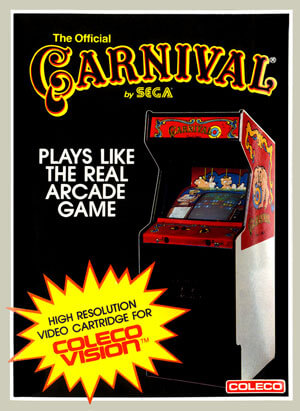
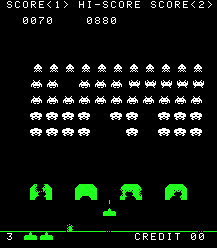
CarnivalThe Arcade Gallery With Nerves
Sega and Gremlin’s deceptively simple arcade classic turns a fairground shooting booth into pure score tension: limited ammo, moving targets, bonus letters, hungry ducks, spinning pipes, carnival music, and one of early gaming’s most memorable “one more round” loops.
Why Carnival still works
- Ammo as tension: every shot matters, so Carnival creates pressure without complex controls.
- Readable escalation: ducks, letters, bullet boxes, and pipes turn a simple gallery into a layered score puzzle.
- Arcade charm: the carnival-waltz audio identity gives the game unusual personality for 1980.
- Historical weight: its bonus-round structure made it an important early arcade rhythm piece.
“Not a war game. Not a maze game. A shooting gallery with nerves.”
Carnival proves how much arcade drama can come from limited bullets, smart target design, and rising panic.
The Shooting Gallery That Became an Arcade Classic
Carnival looks simple at first glance, but that simplicity is exactly why it lasts. You stand at the bottom of the screen, slide left and right, and fire upward at rows of targets. The entire premise is readable in seconds.
Then the game complicates that clarity with limited ammunition, dangerous ducks, rotating pipes, bonus letters, moving bullet boxes, and a constantly shifting score economy. What begins as target practice becomes a game about accuracy, restraint, timing, and nerves.
At a glanceBest approached as a high-score arcade machine where every wasted shot feels personal and every cleared round feels earned.
Game Data
| Title | Carnival |
| Original Release | 1980 |
| Developer | Gremlin Industries |
| Publisher | Sega |
| Original Platform | Arcade / VIC Dual hardware |
| Home Versions | Atari 8-bit, Atari 2600, ColecoVision, Intellivision |
| Genre | Fixed shooter / shooting gallery |
| Players | 1–2 players alternating |
| Theme | Carnival shooting gallery with moving targets and bonus scoring |
| Core Loop | Shoot targets, conserve bullets, collect bonuses, survive ducks, clear rounds |
Gameplay pillars
Ammunition management, target prioritization, duck interruption, bonus-letter timing, rotating-pipe scoring, extra-bullet targets, and fast score optimization.
Premise
There is almost no traditional story. Carnival is framed as a digital shooting booth: targets scroll by, ducks break formation, bonus symbols appear, and the player tries not to run out of ammunition.
Most famous design fact
Carnival is widely remembered as one of the earliest video games with a distinct bonus round, helping establish a pressure-release rhythm that later arcade games used constantly.
Review / Why It Still Feels So Sharp
What makes Carnival immediately effective is that it does not overwhelm the player. The controls are obvious, the objective is obvious, and the playfield is readable within seconds. But pressure appears almost instantly through motion, bullet economy, and target behavior.
Limited ammo is the trickA lot of arcade shooters are about survival in the face of enemy numbers. Carnival is different. Survival is tied to ammunition. Your own impatience can kill you just as fast as the game can.
Why the target design worksRabbits, ducks, owls, bonus letters, pipe values, and bullet boxes create constant micro-decisions. Should you go for points, safety, or ammunition? Do you chase value, or do you stabilize the lower rows first?
Carnival’s music matters more than people sometimes admit. The fairground-style melody gives the cabinet an identity far stronger than a generic shooter soundtrack would have. It reinforces the theme while making the machine immediately memorable.
Where it can feel oldCarnival is still a compact early arcade game. It does not offer modern variety, elaborate stages, or complex movement. Its power comes from pressure, score, repetition, and the way limited ammunition makes every action meaningful.
Final verdictCarnival is a true arcade design piece: small, elegant, tense, and built for repeat play. It does not need a sprawling moveset or dense rulebook. It only needs sharp escalation and disciplined pressure.
Why It Matters
Carnival matters because it shows how quickly arcade design evolved around the turn of the 1980s. It takes a simple interaction — moving a shooter left and right and firing upward — and turns it into a layered score game built around resource management.
It is also historically significant because of its bonus-round rhythm. Pressure, release, reward, and escalation became a huge part of arcade pacing in the years that followed. Carnival helped normalize that structure early.
Finally, the game stands out as an audio-memory piece. Its fairground musical identity, shooting-gallery theme, hungry ducks, and clean readability made it more vivid than many early arcade cabinets with larger but less focused ideas.
Why it mattered then
It wrapped arcade tension in a familiar carnival-gun-gallery fantasy and made it instantly understandable to players.
Why it matters now
It remains a clear lesson in how ammo scarcity, simple controls, and smart target behavior can create deep replay value.
What it changed
It helped popularize the bonus-round rhythm and showed that arcade shooting could be about precision and conservation.
Timeline / Key Milestones
Carnival launches in arcades as a Sega-published Gremlin shooting-gallery game built around limited ammo, scrolling targets, and bonus scoring.
The game becomes associated with one of early arcade gaming’s important structural ideas: a dedicated bonus round after the regular pressure of play.
The design begins moving into home-computing territory, helping Carnival become more than just a cabinet memory.
Carnival reaches Atari 2600, ColecoVision, and Intellivision, bringing its shooting-gallery loop to living-room hardware.
It remains a respected early arcade score game: compact, musical, historically significant, and still surprisingly tense.
The target rows, bonus letters, bullet boxes, spinning pipes, hungry ducks, bear bonus round, fairground tune, and Sega / Gremlin cabinet identity became the memory — but the arcade flyers, ColecoVision box, Atari 2600 cart, Intellivision release, manuals, and cabinet material are the artifacts.
Carnival belongs in the collector lane because it is more than an early shooting game: it is a museum piece for how little an arcade game needs when scarcity, scoring, theme, and rhythm are tuned correctly.
Where to Play / Collect Today
Collecting Carnival means collecting one of early arcade design’s purest pressure loops.
Strong collector routes include original arcade flyers, cabinet documentation, ColecoVision copies, Atari 2600 cartridges, Intellivision releases, manuals, cartridge labels, home-port comparison sets, and early Sega / Gremlin arcade-history material.
A curated starting point for Carnival collectors: arcade and flyer material first, ColecoVision and Atari 2600 versions second, then Intellivision, manuals, labels, and display routes.
eBay Collector Search
The strongest route for physical Carnival material: arcade flyers, ColecoVision boxes, Atari 2600 cartridges, Intellivision copies, manuals, labels, and early Sega / Gremlin collector artifacts.
- Best chance for ColecoVision boxes, Atari 2600 carts, Intellivision copies, manuals, labels, and arcade flyer material.
- Search Carnival arcade, Carnival ColecoVision, Carnival Atari 2600, Carnival Intellivision, Sega Gremlin Carnival, and Carnival manual separately.
- Check box condition, label condition, manual presence, region, reproduction flyers, and cartridge shell wear carefully.
4NERDS collector search for Carnival arcade, Sega / Gremlin material, ColecoVision, Atari 2600, Intellivision, manuals, and flyers.
Amazon Search
Useful for cartridge sleeves, display protection, retro-gaming books, arcade-history reading, storage supplies, and general collector shelf support.
- Better for accessories, books, and storage than rare Carnival-specific originals.
- Good for display cases, cartridge storage, arcade-history books, and home-collection organization.
- Use as a secondary route after eBay collector searches.
Replace YOURAMAZONTAG-20 once the final approved Amazon Associates tag is ready.
Etsy Collector Route
Potentially useful later for Carnival-style shelf labels, fairground arcade display plaques, Sega / Gremlin wall pieces, cartridge stands, and vintage shooting-gallery presentation objects.
- Better suited for display objects than preservation-grade collecting.
- Keep separate from original carts, boxes, manuals, arcade flyers, and cabinet documents.
- Ready to activate once the Etsy strategy is finalized.
Placeholder route kept disabled until a final Etsy affiliate or curated shop strategy is available.