Donkey Kong 3 (1983)
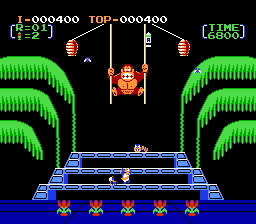
Donkey Kong 3 is a 1983 Nintendo arcade game that flips the series into a shooter-leaning action hybrid. You play as Stanley the Bugman, using a pesticide sprayer to push Donkey Kong upward while surviving swarms of insects and environmental hazards inside a greenhouse.
Game Data
| Release Year | 1983 |
| Developer | Nintendo R&D1 |
| Publisher | Nintendo |
| Platform | Arcade (later ports: Famicom / NES) |
| Genre | Arcade Action / Shooter |
| Players | 1–2 (alternating) |
| Original Media | Arcade Cabinet |
Gameplay:
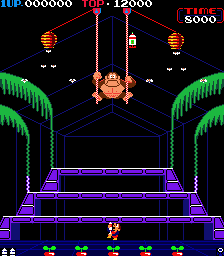
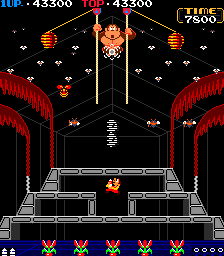
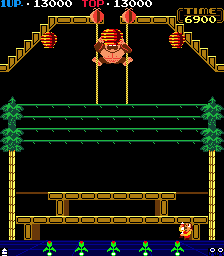
Stanley fires a spray upward—continuous hits push Donkey Kong back toward the top of the screen.
Meanwhile, bugs dive, crawl, or swoop in patterns, forcing you to multitask: control space, time bursts
of spray, and reposition to avoid getting overwhelmed.
Story:
Donkey Kong has invaded Stanley’s greenhouse. As the resident “Bugman,” Stanley defends his plants by
driving DK out—one frantic wave at a time.
Trivia:
Donkey Kong 3 is the oddball of the early trilogy—Mario isn’t the star, and the core loop feels closer to
classic fixed-screen shooters than traditional platforming.
Where Donkey Kong (1981) and Donkey Kong Jr. (1982) leaned on platforming and climbing, Donkey Kong 3 shifts the fantasy into “arcade pressure”: hold your ground, manage lanes, and keep DK moving while the insect patterns ramp up. It’s a great example of how Nintendo experimented with series identity before “franchise rules” hardened.


Screenshots / Media


Timeline / Versions
Why Donkey Kong 3 Was Historically Important
Donkey Kong 3 stands out as an early example of Nintendo experimenting with “series shape” before a franchise formula became fixed. By reframing Donkey Kong as a fixed-screen action shooter—with lane control, pressure management, and escalating hazard patterns—it shows how arcade design in the early 1980s encouraged rapid genre-hybrid iteration. It’s also notable for spotlighting a non-Mario human lead (Stanley), foreshadowing Nintendo’s later willingness to spin recognizable characters into wildly different play styles.