Elite (1984)
Elite is a 1984 space trading and combat game by David Braben and Ian Bell. It pioneered a player-driven “open” galaxy built with procedural generation—letting you trade, fight pirates, hunt bounties, or simply explore.
Game Data
| Release Year | 1984 |
| Developer | David Braben & Ian Bell |
| Publisher | Acornsoft (original) / later ports by various labels |
| Platform | BBC Micro (original) + many home computer ports |
| Genre | Space Trading / Combat Simulation |
| Players | 1 |
| Original Media | Disk / Cassette |
Gameplay:
Pilot a ship, buy low/sell high between systems, upgrade lasers and equipment, and survive dogfights in wireframe space.
Your “rank” rises through combat success—there’s no fixed ending, just a career you shape.
Story:
Elite keeps narrative minimal. The “story” is your route through the galaxy: merchant, pirate, courier, or bounty hunter—
with the economy and danger level changing by system.
Trivia:
Elite’s galaxy is built from procedural generation, enabling a huge number of star systems on tiny 8-bit memory—one of its most
famous technical feats.
Elite helped define the vocabulary of space sims: docking, trading routes, equipment upgrades, and emergent “make your own goals” progression. Its clean wireframe look wasn’t just style—it was a smart way to render 3D combat on limited hardware.


Screenshots / Media

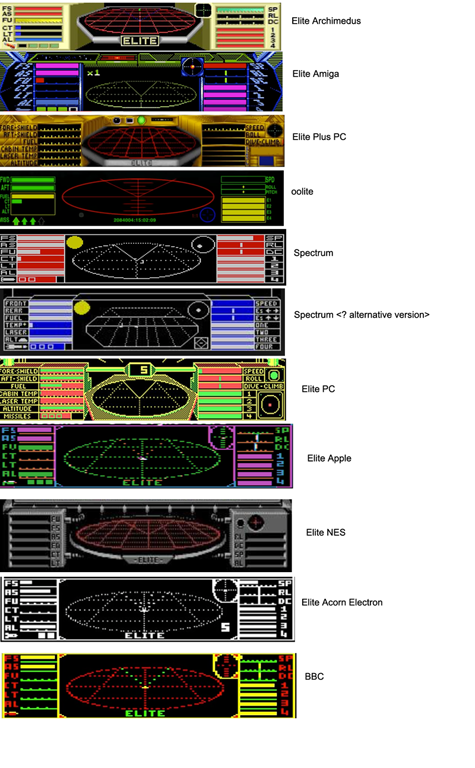

Timeline / Versions
Why Elite Was Historically Important
Elite was a milestone for open-ended design: a large-scale galaxy, an economy to exploit, and a sandbox of careers long before “open world” became standard. Its procedural generation showed how smart algorithms could replace hand-built content, and its wireframe 3D combat helped push home computer games toward true 3D thinking.


