GalaxianThe Invasion Learns to Dive
Namco’s post-Space-Invaders breakthrough: faster formations, colorful animated aliens, dive-bombing attack patterns, and a starfield presentation that helped push arcade shooting games from static pressure into something more alive, aggressive, and modern.
Why Galaxian still works
- Immediate readability: one ship, one screen, one clear survival problem — but far more motion than earlier fixed shooters.
- Dive-bombing tension: enemies do not only descend as a wall; they peel away, attack, curve, and force reactive play.
- Visual leap: the multicolor sprites and starfield presentation made Galaxian feel like a real arcade generation jump.
- Historical weight: it is one of the great bridges between Space Invaders and the more characterful shooters that followed.
“The moment the fixed shooter learned how to swoop, sparkle, and fight back with style.”
Galaxian is not just an early arcade hit — it is one of the first shooters that feels visibly alive.
The Shooter That Put Motion Into the Invasion
Galaxian matters because it takes the basic fixed-shooter logic that players already understood and injects it with energy. The enemy formation is no longer just an advancing block to chip away at. Ships break formation, arc downward, fire back, and create a feeling of aerial combat rather than static siege.
That change seems small on paper, but in play it feels like a genre mutation. Suddenly the player is not only clearing rows, but reading personality: which alien is about to dive, how its angle will bend, whether the flagship escort is worth the risk, and when one clean shot is worth waiting for.
At a glanceBest experienced as a foundational arcade text: simple, sharp, historically essential, and still genuinely tense in short sessions.
Game Data
| Title | Galaxian |
| Original Release | 1979 |
| Original Platform | Arcade |
| Developer | Namco |
| Publisher | Namco; Midway Manufacturing in North America |
| Designers | Kazunori Sawano, Shigeichi Ishimura and Namco team |
| Programmer | Kōichi Tashiro and team |
| Artist | Hiroshi Ono |
| Composer | Toshio Kai |
| Arcade Hardware | Namco Galaxian hardware |
| Series | Galaxian series |
| Genre | Fixed shooter |
| Players | 1–2 players, alternating turns |
| Modern Access | Arcade Archives GALAXIAN on Nintendo Switch and PlayStation 4 |
| Core Loop | Clear formations, dodge dives, snipe flagships, survive longer waves |
Gameplay pillars
Formation reading, dive-bomb reaction, shot timing, one-shot-at-a-time discipline, flagship bonus hunting, and survival through increasingly aggressive attack waves.
Story / setup
The player pilots the Galaxip and defends Earth against alien formations descending from deep space. Minimal fiction, maximum arcade clarity.
Most famous design fact
Galaxian is remembered as one of the first major arcade games to make multicolor sprite action and a moving starfield impression feel like a true technological leap.
Review / Why Galaxian Still Plays So Well
Galaxian is immediately understandable: you sit at the bottom of the screen, aliens form above you, and the goal is to clear the formation before the pressure overwhelms you. But the difference from older fixed shooters is how lively everything feels.
Why the dives matterThe diving aliens create a different psychological rhythm. You are no longer only measuring horizontal rows. You are reading curved attacks, sudden gaps, projectile timing, and the tiny delays between when a shot is possible and when it is safe.
The one-shot disciplineBecause the Galaxip can only keep one shot active at a time, Galaxian demands restraint. A missed shot is not just a miss; it is a small period of vulnerability while your bullet travels. That gives even basic firing a tactical edge.
Galaxian’s historical reputation is tied closely to how it looked. The color, sprite animation, and starfield energy made the game feel more technologically alive than many earlier black-background arcade shooters.
Where it shows its ageCompared to Galaga, Galaxian is simpler, stricter, and less generous. It does not have the captured-ship gamble or challenge-stage rhythm that later made Galaga so addictive. But that simplicity is also its identity.
Final verdictGalaxian remains essential because it shows the fixed shooter in transition: still one screen, still simple, still brutally readable — but suddenly faster, more colorful, and much more animated. It is the missing bridge between Space Invaders and Galaga.
Why It Matters
Galaxian is historically important because it helped move arcade shooters beyond the static wall pressure of the earliest fixed-shooter wave. It kept the single-screen clarity, but added dramatic enemy behavior, stronger animation, color spectacle, and a more aggressive sense of motion.
It also mattered because it gave Namco a major arcade identity before Pac-Man and Galaga became even larger cultural names. Galaxian proved the company could respond to the Space Invaders phenomenon with its own technological and design personality rather than simply copying the formula.
Most importantly, Galaxian created the foundation for the Galaxian line. Without its diving aliens, flagship bonus thinking, colorful presentation, and hardware direction, Galaga’s later refinement would not have had the same design base to build from.
Why it mattered then
It made the fixed shooter feel faster, brighter, and more animated at exactly the moment arcades were searching for the next post-Invaders step.
Why it matters now
It remains one of the clearest ways to understand how early arcade design evolved from static survival into more dynamic enemy behavior.
What it changed
It helped establish colorful formation shooters, diving attack patterns, and the Galaxian family that would later lead to Galaga.
Timeline / Key Milestones
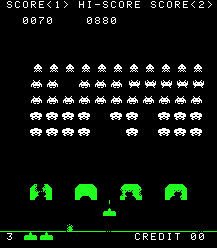
Taito’s blockbuster creates the fixed-shooter template Galaxian would answer with more color, motion, and attack personality.
Galaxian launches in Japan and establishes Namco’s first major post-Invaders arcade breakthrough.
Midway brings Galaxian to North America, helping the cabinet become one of the major early golden-age arcade names.
Namco builds on Galaxian’s formation-shooter DNA with Galaga, adding the famous captured-ship / Dual Fighter system.
The series continues with more experimental systems and a busier, more mobile take on the formula.
Hamster’s Arcade Archives release brings the original arcade game to modern platforms with preservation-focused options.
Galaxian remains an essential historical bridge between Space Invaders and Galaga, and a landmark in early color arcade shooting.
The Galaxip, diving aliens, Galboss / flagship bonus route, starfield impression, colorful sprites, Namco and Midway cabinet history, cocktail-table route, Galaga lineage, early home ports, Namco Museum appearances, and Arcade Archives preservation became the memory — but the cabinets, boards, flyers, ports, manuals, compilations, and reissues are the artifacts.
Galaxian belongs in the collector lane because it is more than a predecessor: it is one of the earliest arcade games where color, motion, cabinet art, and enemy behavior clearly announce the next step of the medium.
Where to Play / Collect Today
Collecting Galaxian means collecting the bridge between Space Invaders and Galaga.
Strong collector routes include original arcade cabinets and boards, marquees, control panels, flyers, Midway cabinet material, Atari and Famicom / Namco home versions, Namco Museum compilations, plug-and-play devices, Arcade Archives access, Galaga / Gaplus family context, and display pieces that capture the colorful star-invasion identity.
A curated starting point for Galaxian collectors: arcade material first, home ports and compilations second, then flyers, manuals, control-panel pieces, cabinet art, display supplies, and modern preservation access.
eBay Collector Search
The strongest route for physical Galaxian material: arcade PCBs, cabinet parts, marquees, flyers, Midway / Namco items, Atari and Famicom ports, Namco Museum compilations, manuals, instruction cards, and Galaxian-family collector lots.
- Best chance for arcade boards, flyers, cabinet art, manuals, regional variants, ports, and compilation lots.
- Search Galaxian arcade PCB, Galaxian flyer, Galaxian marquee, Galaxian cabinet, Galaxian Atari, Galaxian Famicom, and Namco Museum separately.
- Check board condition, authenticity, cabinet state, region, artwork quality, manual presence, and seller photos carefully.
4NERDS collector search for Galaxian arcade, PCB, cabinet, flyer, marquee, manuals, Namco / Midway material, and home ports.
Amazon Search
Useful for retro-game storage, display cases, arcade-history books, controller accessories, Namco Museum collections, mini-arcade routes, and shelf organization around a Galaxian / golden-age arcade collection.
- Better for accessories, books, display supplies, and modern collection routes than rare original arcade material.
- Good for storage cases, shelf organization, arcade history books, controller options, and broader Namco context.
- Use as a secondary route after eBay collector searches.
Replace YOURAMAZONTAG-20 once the final approved Amazon Associates tag is ready.
Etsy Collector Route
Potentially useful later for Galaxian-style shelf labels, alien-formation display plaques, golden-age arcade dividers, cabinet-room wall pieces, and early color-shooter display objects.
- Better suited for display objects than preservation-grade collecting.
- Keep separate from original cabinets, boards, flyers, official ports, compilations, and verified releases.
- Ready to activate once the Etsy strategy is finalized.
Placeholder route kept disabled until a final Etsy affiliate or curated shop strategy is available.