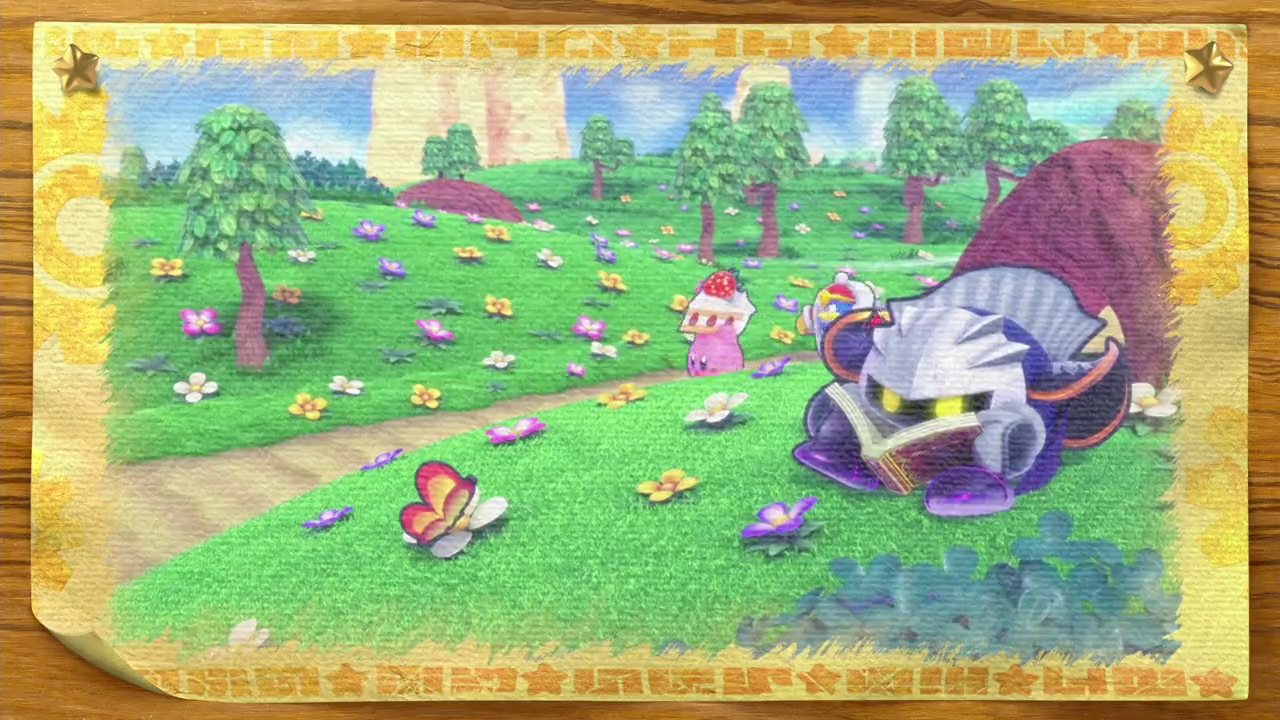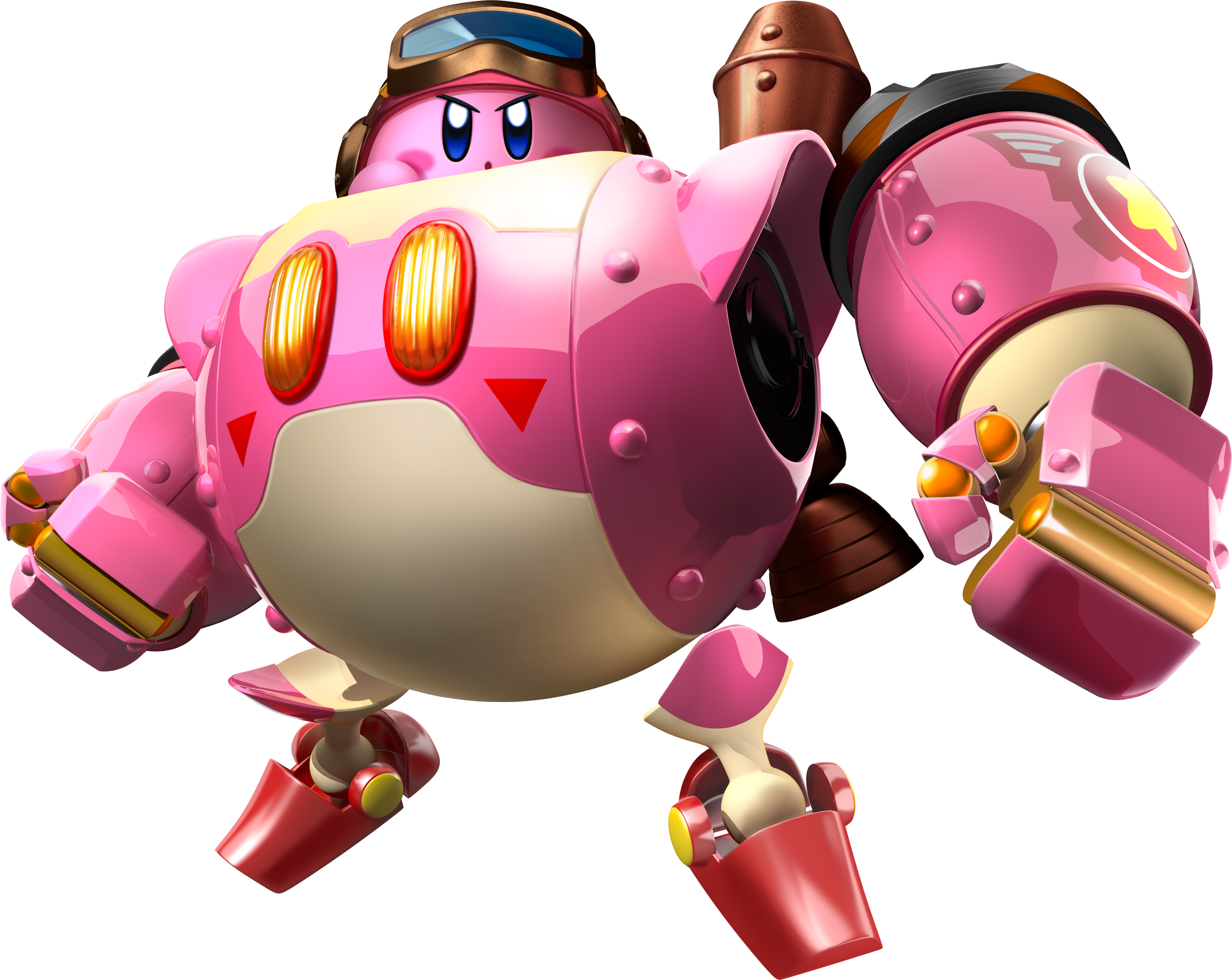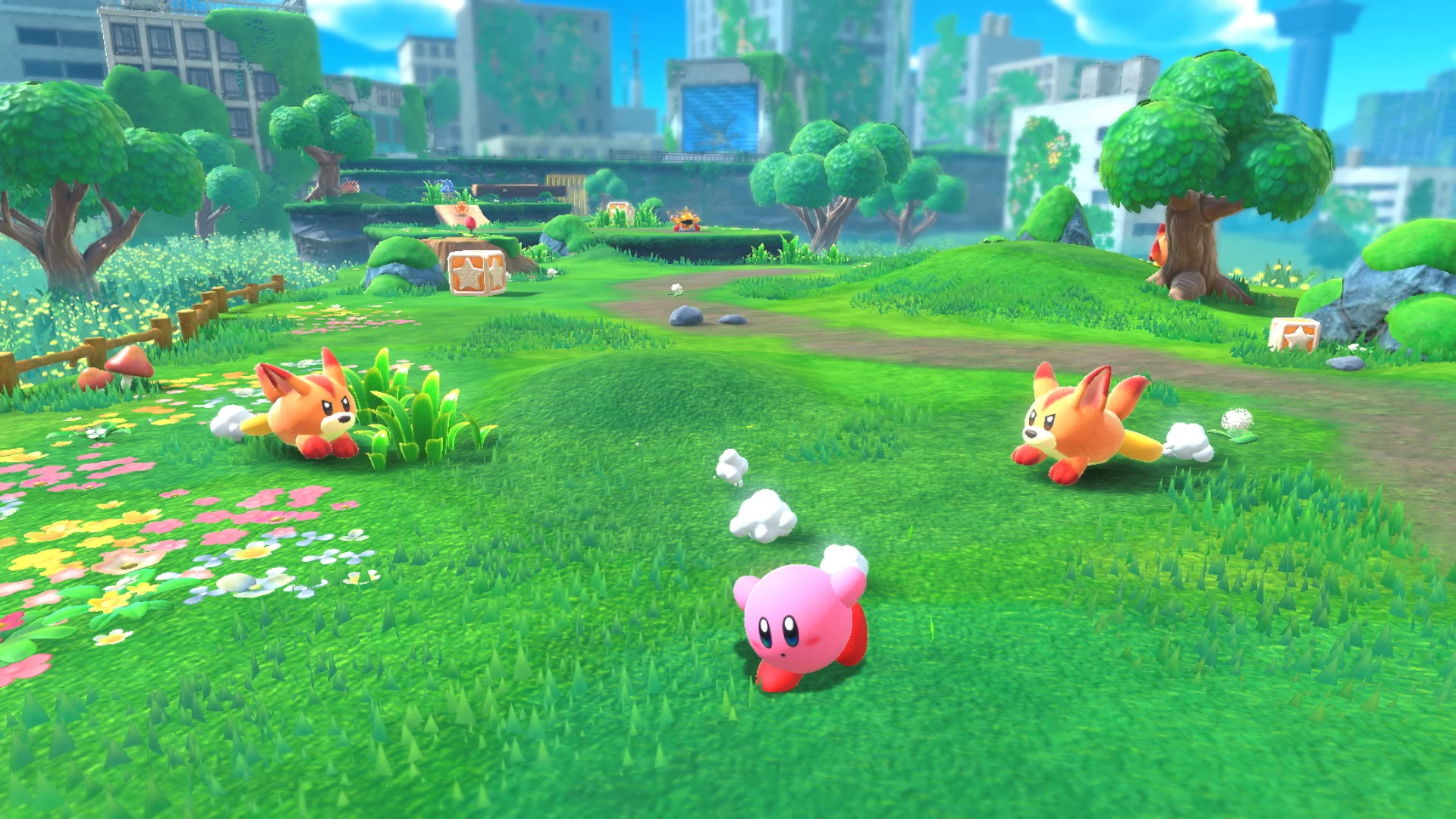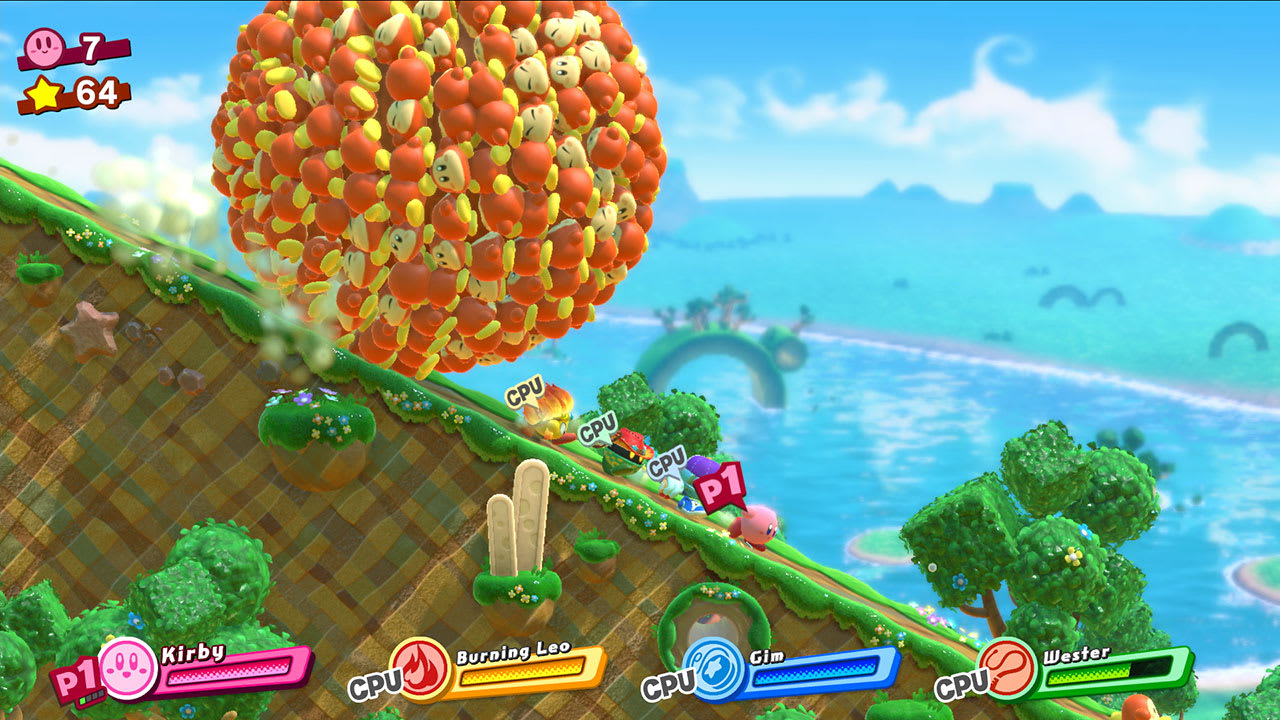
- Friendship as a mechanic: tossing Friend Hearts at enemies creates one of the most charming recruitment systems in the series.
- Pure co-op joy: few Kirby games are this built around relaxed 4-player drop-in play.
- Creative power mixing: fire, ice, electricity, and team actions make even simple movement feel playful.
- Legacy payoff: the free Dream Friends updates turn the game into a broad celebration of Kirby history.
“Less about danger, more about delight — Kirby as a playable celebration.”
A softer, more communal mainline entry that becomes richer the more you care about the series around it.
Kirby as a Friendship Machine
Kirby Star Allies feels different from the moment it begins because the mood is not built around struggle first, but around companionship. Enemies become helpers. Helpers become puzzle tools. Powers combine into elemental tricks. Whole sections are built not around surviving a harsh world, but around moving through it as a tiny, colorful team. That gentleness can make the game feel easy, but it is also exactly what gives it identity. Star Allies is not trying to be the hardest Kirby. It is trying to be the most openly collaborative one.
Game Data
| Title | Kirby Star Allies |
| Release Year | 2018 |
| Developer | HAL Laboratory |
| Publisher | Nintendo |
| Platform | Nintendo Switch |
| Genre | Action platformer |
| Players | 1–4 players simultaneous |
| Original Format | Game Card / Digital Download |
| Core Loop | Befriend, combine, explore, clear, celebrate |
Friend Hearts, co-op platforming, elemental combination powers, Friend Actions, Dream Friends, and lightweight but constant puzzle-combat flow.
After dark Jamba Hearts scatter across the galaxy, Kirby gathers allies old and new to stop Hyness, the Mage-Sisters, and the apocalyptic force known as Void Termina.
This was the first mainline Kirby release on home console hardware since Kirby’s Return to Dream Land in 2011, and it later expanded through three free Dream Friends update waves.
Review / Why It Feels So Generous
The first impression Star Allies makes is one of softness, but not weakness. Kirby still slides, floats, copies, and clears enemies with the same readable confidence the series is known for, yet everything here is shaped toward cooperation. The Friend Heart system is the key. Instead of simply removing enemies, you can recruit them, and that instantly changes the tone. Levels stop feeling like obstacle courses full of disposable threats and start feeling like spaces filled with potential teammates.
WHY THE CO-OP WORKSThis is one of the most naturally social Kirby games because it is generous with participation. Friends can drop in. CPU partners keep the pace alive when you are alone. Puzzles often feel collaborative without turning into exhausting stop-start coordination tests. In the best sessions, Star Allies becomes a rhythm game of shared momentum: somebody grabs fire, somebody grabs water, someone else spots the route, and the whole group keeps moving forward with almost no friction.
THE BEAUTY OF COMBINATION PLAYElemental ability mixing is where the game really earns its identity. A sword can become a blazing weapon. Water and electricity can reshape attacks and puzzle interactions. Whole formations such as Friend Circle or Friend Train turn teamwork into spectacle. None of these systems are complicated in a technical sense, but they are delightful in a tactile sense. That matters. Star Allies understands that joyful interaction can be more memorable than raw complexity.
WHERE IT DIVIDES PLAYERSThe main criticism is easy to understand: the campaign can feel too forgiving. If you arrive wanting a demanding, tightly tuned challenge in the style of Kirby’s hardest post-game content, the main road here may seem almost overly smooth. Bosses, levels, and hazards often prioritize accessibility over pressure. For some players that makes the game float a little too lightly. For others, it is exactly what allows the co-op structure to stay pleasant rather than stressful.
THE POST-LAUNCH REPUTATION BOOSTWhat truly improved the game’s standing over time was its update path. The Dream Friends waves turned Star Allies into more than a charming 2018 platformer. It became a historical showcase. Suddenly, longtime Kirby fans could play with characters that felt like living museum pieces from across the series timeline. That fan-service is not empty. It changes how the game feels, broadens its texture, and gives the whole package stronger archival weight.
FINAL VERDICTKirby Star Allies may never be the hardest or most mechanically intense mainline Kirby, but it is one of the most openly affectionate. It is a game about friendliness as interaction design, about celebration as progression, and about Kirby’s history being something you can actively play with. In that role, it succeeds beautifully.
Why Historically Important
Kirby Star Allies matters because it sits at a very specific turning point for the series. It was the first mainline Kirby on home console hardware since Return to Dream Land, which already gives it weight inside Kirby history. But more importantly, it reintroduced Kirby as a large-screen, shared-sofa Nintendo character during the early Switch years, when local multiplayer visibility mattered a great deal.
It also pushed the series into a more openly archival direction. The Dream Friends updates were not just bonus extras. They reframed the game as a crossover celebration of past Kirby eras, characters, mechanics, and fan memory. Star Allies became part platformer, part playable Kirby museum, and that makes it unusually valuable as a series-history artifact.
Finally, it stands as a major developmental bridge. The game kept Kirby in the familiar side-scrolling tradition while broadening presentation, spectacle, and cooperative systems. It helped close one chapter of mainline Kirby design just before Forgotten Land opened the next. That gives Star Allies a strong place in the lineage: it is both culmination and transition.
Timeline / Key Milestones
The project is announced as Kirby for Nintendo Switch, introducing Friend Hearts, co-op focus, and the new “allies” identity.
Kirby Star Allies releases on Nintendo Switch and becomes the first mainline home-console Kirby since Return to Dream Land.
The first free update adds Dream Friends like Rick, Kine & Coo, Marx, and Gooey, beginning the game’s transformation into a series tribute.
More Dream Friends arrive, deepening the crossover appeal and making the game feel increasingly expansive for longtime Kirby fans.
The final major update completes the Dream Friends rollout and helps lock in Star Allies’ long-term reputation as a celebratory Kirby package.
In hindsight, Star Allies reads as the last grand 2D-style celebration before the series’ full 3D leap with Kirby and the Forgotten Land.
4NERDS Collector Marketplace
A curated access point for Kirby fans, Switch collectors, co-op players, and Nintendo archive builders: current market searches, retail options, shelf pieces, and future handmade finds — clearly marked as partner links where applicable.
Shop Kirby Star Allies finds
Browse current Kirby Star Allies offers on eBay — useful for physical Switch copies, regional variants, sealed copies, used game-card listings, and broader Kirby Switch-era collectibles.
- Physical Switch copies and variants
- Used, boxed, sealed, and collector listings
- Condition, seller, and price comparison
Paid partner link / Werbung — availability, seller terms, shipping, and pricing depend on eBay sellers.
Browse Kirby on Amazon
Explore Amazon for Kirby Star Allies, Kirby-related merchandise, Switch accessories, Nintendo display items, gifts, books, and broader Kirby archive extras.
- Kirby-related games and products
- Switch accessories and gift ideas
- Broader Kirby and Nintendo browsing
Paid partner link / Werbung — as an Amazon Associate, 4NERDS Gaming may earn from qualifying purchases.
Curated Etsy picks coming soon
Planned for handmade Kirby-inspired art, co-op-themed prints, shelf decor, framed display pieces, and museum-style collectibles that match the 4NERDS archive aesthetic.
- Wall art and display-focused pieces
- Handmade and fan-crafted style items
- Added once the setup is ready
Etsy affiliate integration will be added after the tracking setup is approved and tested.