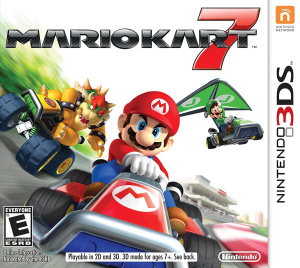
- Portable precision: drifting, snaking-era speed tech, and item timing give the racing real bite.
- Track identity: courses like Delfino Square, Waluigi Pinball, and Peach Gardens still feel instantly nameable.
- Series milestone: retro cups and full Nintendo WFC online play made it feel like a major step forward for Mario Kart.
- Replay power: Grand Prix, Time Trials, Missions, local multiplayer, unlocks, and records keep it easy to revisit.
“The DS entry that made Mario Kart feel small enough to carry and big enough to obsess over.”
Not just a strong handheld spin on the formula — one of the defining Mario Kart games, period.
Portable Mario Kart Finds Its Perfect Form
Mario Kart DS lands at a fascinating point in Nintendo history. It feels traditional enough to satisfy fans of Mario Kart 64 and Double Dash!!, but ambitious enough to push the series into a new shape. You get 32 tracks, a sharp handheld presentation, a mission mode that no later mainline entry quite copied in the same way, and an online component that made schoolyard, sofa, and internet rivalry suddenly live under one roof. It is easy to start, but hard to stop refining.
Game Data
| Title | Mario Kart DS |
| Release Year | 2005 |
| Developer | Nintendo EAD |
| Publisher | Nintendo |
| Platform | Nintendo DS |
| Genre | Kart racing |
| Players | 1–8 players |
| Original Format | Nintendo DS Game Card |
| Core Loop | Drift, boost, attack, recover, optimize, repeat |
Drift timing, mini-turbo rhythm, item management, shortcut learning, map awareness, and high-value route discipline under pressure.
Like the best Mario Kart entries, the “story” is essentially the event itself: Mario’s cast racing for cups, bragging rights, and pure arcade dominance across Nintendo-themed courses.
This was the first Mario Kart to pair a Nitro Grand Prix with a Retro Grand Prix, helping establish the now-standard structure of new tracks plus returning classics.
Review / Why It Still Plays So Well
Mario Kart DS makes a powerful first impression because it wastes almost no time explaining itself. Pick a driver, pick a kart, hit the gas, and the game begins teaching through motion. The turning feels immediate, the drifting has real consequence, and the item flow lands in that sweet Mario Kart zone where chaos is constant but never fully random. Even today, it still reads cleanly and plays fast.
DRIFT, SPEED, AND PORTABLE COMPETITIONA big part of the game’s staying power is its mechanical sharpness. Mario Kart DS is accessible enough for casual races, but under the surface it is full of timing, line choice, and technical optimization. The drift system is satisfying almost instantly, yet also deep enough to support obsessive improvement. That is why the game works both as a family-party racer and as a serious Time Trial machine.
TRACK IDENTITYOne reason this entry remains so beloved is that the courses do not blur together. Delfino Square feels like a compact tourist postcard turned into a race route. Peach Gardens turns stately spaces into a playful navigation problem. Waluigi Pinball is loud, ridiculous, and unforgettable in exactly the right way. Even the simpler tracks tend to communicate a clear visual or mechanical idea quickly, which is essential on handheld hardware.
MISSIONS, ONLINE, AND THE FEEL OF ABUNDANCEMario Kart DS also feels richer than many people remember. Mission Mode gives the game a distinctive side lane, turning Mario Kart mechanics into short-form challenge design. Retro cups make the series feel self-aware in a new way. Then there is the historical buzz of Nintendo Wi-Fi Connection: for many players, this was one of the most memorable online experiences on a Nintendo handheld. That combination of local, solo, and online value makes the package feel unusually complete.
FINAL VERDICTMario Kart DS is not just “great for a handheld.” It is one of the most important Mario Kart games because it tightened the portable feel, expanded the content structure, normalized retro tracks, and proved that online Mario Kart could matter. Its visuals are of their time, and some elements are simpler than later entries, but the core design still has remarkable energy. It remains easy to recommend, easy to admire, and very easy to keep replaying.
Why Historically Important
Mario Kart DS matters because it did more than simply compress Mario Kart onto a handheld. It changed the expectations for what a portable Mario Kart could be. The game offered a substantial track count, strong local multiplayer, mission-based side content, unlockables, and a structure that made the series feel bigger rather than smaller.
It is also a major design turning point. The Nitro / Retro split became one of the defining patterns of later Mario Kart entries. Returning tracks stopped feeling like bonus nostalgia and started feeling like an essential part of the franchise’s identity. In that sense, Mario Kart DS helped teach the series how to remember itself.
Then there is online play. For a lot of players, this was one of the first times Nintendo’s family-friendly racing chaos extended beyond the living room in a meaningful way. Even though Nintendo WFC is long gone, its existence shaped how players remember the game and how Nintendo would later scale networked Mario Kart across future hardware generations.
Timeline / Key Milestones
Mario Kart DS arrives on Nintendo DS and immediately stands out as a major handheld showcase rather than a scaled-down side entry.
The game becomes the first Mario Kart with Nintendo Wi-Fi Connection online play, expanding the series beyond couch and local-link rivalry.
Local Download Play, school-break battles, emblem sharing, and early internet matchups turn it into a defining social game of the DS generation.
Nintendo Wi-Fi Connection support ends, closing the official online chapter but not the game’s reputation as an online pioneer for the series.
The game is reissued digitally for Wii U, keeping the title visible in Nintendo’s historical catalog even after the original DS-era moment had passed.
Mario Kart DS remains one of the most cited handheld entries in the franchise and one of the clearest examples of retro-cup structure done right.
4NERDS Collector Marketplace
A curated access point for players, collectors, and retro fans: original-market searches, modern related items, and future handmade display pieces — clearly marked as partner links where applicable.
Shop original DS copies
Browse current Mario Kart DS offers on eBay — useful for loose cartridges, boxed editions, manuals, regional versions, bundles, and collector-grade finds.
- Original Nintendo DS-era copies
- Loose carts, boxed versions, and manuals
- Condition, language, and price comparison
Paid partner link / Werbung — availability and pricing depend on eBay sellers.
Browse related Mario Kart finds
Explore Amazon for Mario Kart-related books, guides, themed accessories, Nintendo-related products, DS-era nostalgia items, and retro-inspired collector extras.
- Books, merch, and accessories
- Gift ideas and modern products
- Broader Mario Kart-themed browsing
Paid partner link / Werbung — as an Amazon Associate, 4NERDS Gaming may earn from qualifying purchases.
Curated Etsy picks coming soon
Planned for handmade retro art, display objects, shelf pieces, prints, and museum-style collectibles that match the 4NERDS archive aesthetic.
- Wall art and display-focused pieces
- Handmade and fan-crafted style items
- Added once the setup is ready
Etsy affiliate integration will be added after the tracking setup is approved and tested.
Transparency note: 4NERDS Gaming does not sell these items directly. External shops, prices, stock, shipping terms, and seller conditions may change at any time. eBay and Amazon links in this section are sponsored / paid partner links. Etsy is currently shown as an upcoming integration and does not link out yet.