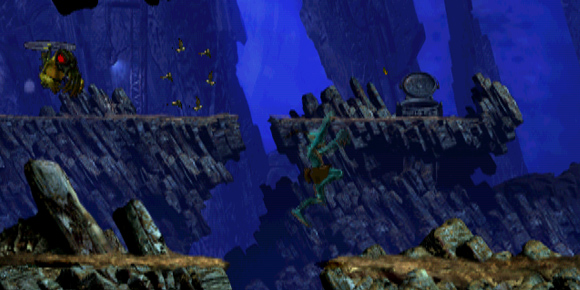
- Atmosphere with teeth: RuptureFarms still feels filthy, oppressive, and unforgettable.
- Distinct mechanics: GameSpeak, possession, stealth movement, and rescue routing create a play style no Mario-clone ever touched.
- Real stakes: saving Mudokons gives the game emotional weight beyond simply reaching the exit.
- Cult legacy: it helped make Oddworld one of the most unusual and socially charged platforming universes of its era.
“A cinematic platformer with satire, soul, and actual rescue stakes.”
Not just weird for the sake of being weird — a carefully built industrial fable that still stands apart.
An Industrial Escape Story Unlike Anything Else in 1997
Oddworld: Abe’s Oddysee still feels fresh because it refuses to behave like a normal mascot-era platformer. It is slower, meaner, stranger, and much more deliberate. Every screen asks you to observe first and act second. Every Slig patrol, mine placement, chant sequence, and Mudokon rescue turns progress into a little tactical drama. Beneath the alien humor sits a pointed story about labor, exploitation, environmental ruin, and survival — and that mood is a huge part of why the game still lingers.
Game Data
| Title | Oddworld: Abe’s Oddysee |
| Release Year | 1997 |
| Developer | Oddworld Inhabitants |
| Publisher | GT Interactive |
| Platform | PlayStation / MS-DOS / Windows |
| Genre | Cinematic puzzle platformer |
| Players | 1 player |
| Original Format | CD-ROM / PlayStation disc |
| Japan Title | Abe a Go Go |
| Core Loop | Observe, sneak, solve, rescue, survive |
Screen-by-screen stealth, environmental traps, GameSpeak commands, enemy possession, Mudokon escorting, and careful checkpoint-based progression.
Abe is a Mudokon slave working in RuptureFarms until he learns his own species is next on the menu. He escapes the factory, discovers a larger destiny, and returns not just to survive — but to save as many of his people as he can.
The number of Mudokons you rescue changes the ending, giving the game a genuine moral and structural hook beyond simple completion.
Review / Why It Still Hits So Hard
The first thing Oddworld gets right is mood. Before you fully understand its systems, you already understand its world: this is a place where corporations grind bodies into product lines, where advertising is grotesque, and where the hero is not a swaggering action lead but a frightened worker in over his head. That shift alone made the game stand out in 1997, and it still does.
MOVEMENT, TIMING, AND TENSIONAbe does not move like a frictionless modern character. He commits to jumps, hesitates at edges, and lives inside a screen-by-screen rhythm that demands planning. That can feel stiff if you come in expecting instant responsiveness, but it is also the source of the game’s tension. Oddworld is about reading danger, not improvising out of it at the last millisecond.
GAMESPEAK, POSSESSION, AND RESCUE ROUTINGWhat really makes Abe’s Oddysee special is the stack of mechanics around simple platforming. You say hello. You tell Mudokons to wait. You guide them to portals. You chant to possess Sligs. You use enemies against their own security systems. Suddenly the game is not just about getting across a gap — it is about command, rescue, stealth, and understanding a hostile workplace from the inside.
THE WORLD ITSELFOddworld’s biggest triumph may be how fully imagined it feels. The alien language, the fake food ads, the grotesque products, the creature hierarchy, and the constant suggestion of a bigger mythology all make the setting feel more than decorative. It is one of those rare 90s game worlds where the art direction and the themes are clearly talking to each other.
FINAL VERDICTOddworld: Abe’s Oddysee is not flawless — it can be punishing, occasionally fiddly, and very much of its checkpoint era. But its identity is so strong, and its design ideas so specific, that it still feels essential. It is one of the great examples of a game becoming memorable not by being broad, but by being unmistakably itself.
Why Historically Important
Abe’s Oddysee matters because it revived and reimagined the cinematic platformer tradition for the late 1990s. Instead of chasing mascot cheerfulness, it leaned into industrial horror, social satire, and puzzle-driven tension. The result was a game that felt alien in the best possible way: recognizably a platformer, but built around rescue logic, GameSpeak, possession, and oppressive atmosphere.
It also helped establish Abe as one of PlayStation’s strangest era-defining figures. Oddworld never became a mainstream mascot empire on the scale of Mario or Sonic, but it became something arguably more durable in cult terms: a world with a clear voice, a strong visual identity, and themes people still remember long after they forget individual levels.
Its legacy is visible not just in its own sequels and remake, but in how often players still point to it when discussing darkly comic world-building, anti-corporate storytelling, and platformers that trust observation and planning over raw reflex.
Timeline / Key Milestones
Abe’s Oddysee releases on PlayStation and PC, introducing RuptureFarms, Abe, the Mudokons, and the entire industrial mythology of Oddworld.
The direct follow-up expands the rescue formula, adds quick-save functionality, and deepens the world just one year later.
The original game reappears digitally for PlayStation platforms, helping preserve access after the disc era.
A full ground-up remake modernizes the visuals and controls while keeping the spine of the original adventure intact.
Sony’s modern PlayStation emulation release gives the original version another official path onto contemporary hardware.
It remains one of the most distinctive late-90s cinematic platformers and still defines how many players think about the Oddworld universe.
Where to Play / Collect Today
PS4 / PS5 emulated release
The cleanest modern console route is Sony’s PlayStation emulation version, which adds convenience features like rewind and quick save while preserving the original release.
PLAYSTATION OPTIONClassic PC storefronts
Oddworld still supports official PC storefront paths for the original game, making the classic version easy to revisit without hunting original discs.
PC CLASSICOddworld: New ’n’ Tasty
If you want the same core story with a more contemporary visual shell and a friendlier on-ramp, the remake is the obvious comparison point.
SEE REMAKE