- Fantasy fulfillment: it lets you fight in large-scale Star Wars battles instead of merely watching them.
- Battlefield logic: command posts, reinforcement tickets, vehicles, and map flow give every match momentum.
- Instant readability: even years later, its classes, factions, and objectives are easy to understand and fun to replay.
- Historical weight: Battlefront 2004 is the template that made the series matter before the better-known sequel expanded it.
“Not the deepest shooter of its era — but one of the clearest Star Wars fantasies ever made playable.”
It wins through scale, atmosphere, and the joy of being dropped into the middle of legendary conflicts.
The Shooter That Let You Live Inside the Battles
Star Wars: Battlefront still matters because it understood a very specific fantasy better than many licensed games before it. Players did not merely want to stand next to famous characters or reenact a narrow movie scene. They wanted to be in the war. Battlefront turns that desire into a ruleset of command posts, reinforcement tickets, vehicles, class roles, and broad, movie-iconic maps. The result is not a hyper-technical shooter. It is something more immediately powerful: a Star Wars battlefield generator that still feels readable, atmospheric, and surprisingly robust when you return to it.
Game Data
| Title | Star Wars: Battlefront |
| Release Year | 2004 |
| Developer | Pandemic Studios |
| Publisher | LucasArts |
| Original Platforms | Windows, PlayStation 2, Xbox |
| Later Port | Mac OS X |
| Genre | First-/third-person shooter |
| Modes | Single-player, split-screen, multiplayer |
| Engine | Zero |
| Core Loop | Capture posts, drain reinforcements, use classes and vehicles, hold the line |
Command-post conquest, reinforcement-ticket warfare, class switching, vehicles, starfighters, hero cameos, and big maps pulled from both the prequel and original trilogies.
Historical Campaign, Galactic Conquest, and Instant Action give the game its rhythm: one mode for flavor, one for strategy, and one for pure repeatable chaos.
Battlefront made the “ordinary soldier in the Star Wars war machine” fantasy mainstream by mixing infantry, vehicles, and cinematic locations in one easy-to-read structure.
Review / Simple Systems, Massive Fantasy Payoff
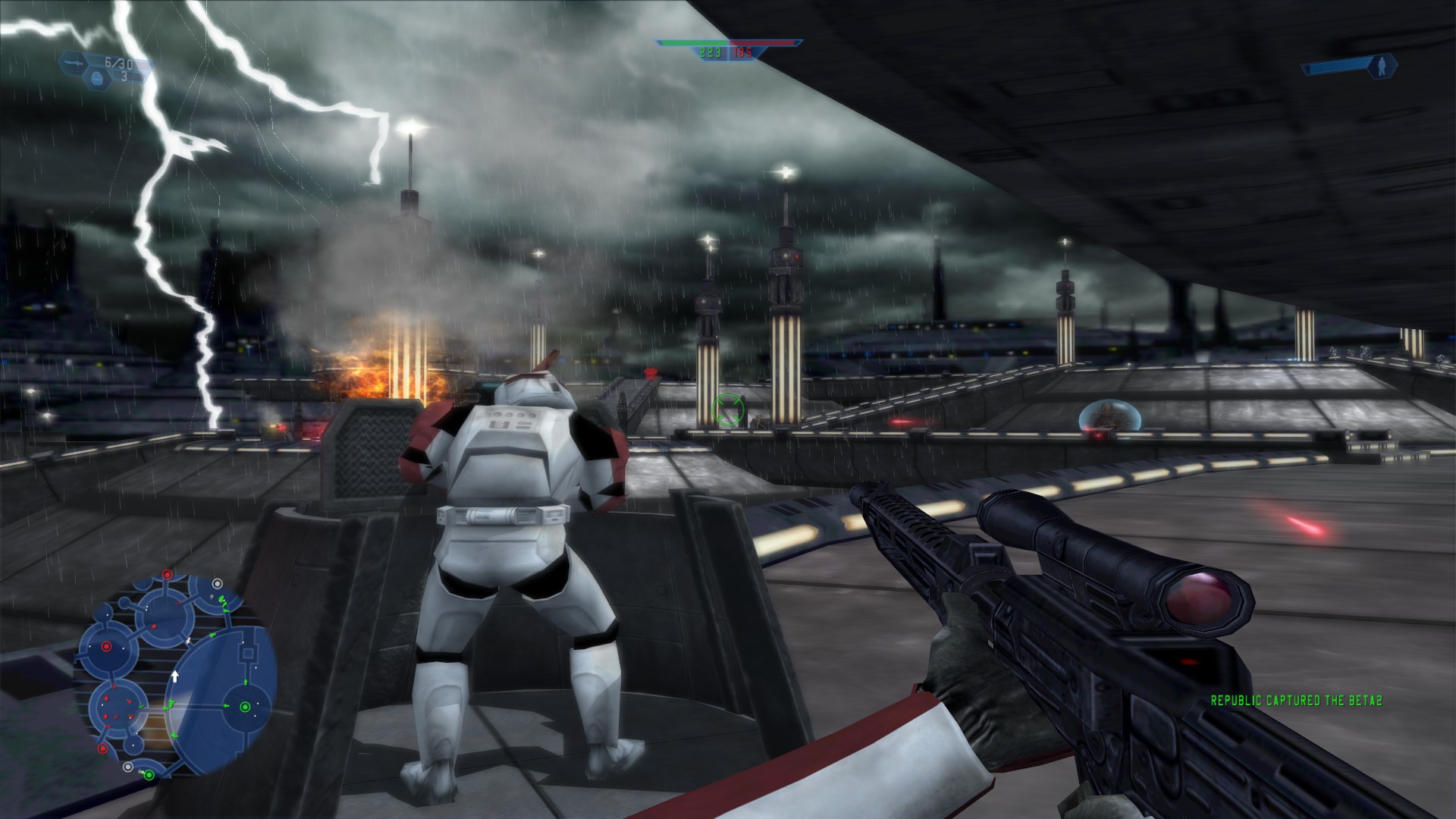
The first thing Battlefront still gets right is scale. You spawn into conflict, not into a corridor. There are walkers in the distance, command posts shifting hands, AI soldiers constantly colliding, and a battlefield that feels active even before you fully understand it. That sensation matters. It gives the game an instant sense of presence that many more mechanically refined shooters still struggle to create.
WHY THE LOOP WORKSCapture command posts, protect your own, drain enemy reinforcements, use vehicles when the situation demands it. That is not an especially difficult structure to explain, but it is a powerful one because it continuously creates readable mini-goals. Even when the AI is uneven or the firefights are not especially sophisticated, the battlefield logic keeps you moving and keeps the match legible.
THE JOY OF BEING A SMALL PIECE OF A BIG WAROne of Battlefront’s smartest design choices is refusing to make the player the center of the universe. You are often just another trooper in a broader machine. That is precisely why the fantasy works. The game captures something essential about Star Wars battles: not only the icons, but the mass of them. Clones, droids, rebels, stormtroopers, turrets, speeders, gunships, walkers — the spectacle comes from the combined picture.
WHERE AGE SHOWSThe game’s limitations are real. Shooting feel has aged. AI can be erratic. The campaign framing is thinner than players may remember. Some maps and class roles also feel more elegant in concept than in strict balance. But Battlefront survives those rough edges because its underlying fantasy remains unusually strong. It is a game you understand emotionally before you fully analyze it mechanically.
FINAL VERDICTStar Wars: Battlefront remains important because it translated blockbuster sci-fi warfare into something approachable, replayable, and immediately theatrical. It may not be the most polished shooter of its era, but it is one of the clearest examples of a license and a gameplay structure fitting together with real force.
Why Historically Important
Star Wars: Battlefront is historically important because it solved a long-standing fantasy problem for Star Wars games. It did not ask what it was like to be the single chosen hero in a tightly scripted sequence. It asked what it was like to be inside the war itself. That framing let the game convert large cinematic battles into a format players could instantly grasp: command posts, reinforcements, classes, vehicles, and attrition.
It also helped establish one of the most successful directions the franchise would ever take in games. The Battlefront name became meaningful because this first game proved the premise worked. The sequel is often remembered as the more complete classic, but the 2004 original is the critical first step — the piece that turned the idea from wishful thinking into a real series template.
Beyond Star Wars, Battlefront also stands as a strong example of early-2000s licensed design done right: broad appeal, clear objectives, high fantasy payoff, and enough systemic structure to make repeated battles worth returning to. It shows how much power there is in letting a player be part of a world rather than merely adjacent to it.
Timeline / Key Milestones
Battlefront releases on PlayStation 2, Xbox, and Windows and immediately lands as the first major large-scale shooter in the Star Wars universe.
The Mac version arrives, and the success of the original helps pave the way for the more feature-rich Battlefront II later that same year.
The game settles into a beloved multiplayer-memory space: LAN sessions, split-screen duels, and endless Instant Action map rotations.
The DICE reboot brings the name back into the mainstream, but many players continue pointing to the Pandemic originals as the series’ most direct fantasy fulfillment.
The original Battlefront is bundled into the Classic Collection, bringing the 2004 game back to current platforms and reintroducing it to a new audience.
Even when Battlefront II gets the louder nostalgia, the 2004 original still stands as the game that established what Battlefront was supposed to feel like.
Where to Play / Collect Today
Classic Collection / modern storefront route
The simplest current path is the modern re-release ecosystem, especially if you want a quick way to revisit the original without hunting old hardware.
MODERN OPTIONPS2 / original Xbox / early PC setup
For the true period feel, the 2004 console and PC versions still deliver that exact mix of softness, scale, split-screen memory, and early-online energy.
COLLECTOR ROUTEInstant Action / local multiplayer sessions
Battlefront shines as a repeat-play comfort game, especially when treated as a map-rotation battle sandbox instead of a one-and-done campaign experience.
SEE VERSION4NERDS Collector Marketplace
Curated collector routes for Star Wars: Battlefront (2004) — original PS2 copies, Xbox and PC editions, manuals, discs, guides, and future display pieces for a proper Star Wars gaming shelf.
Shop original Battlefront copies
Best route for PlayStation 2 discs, boxed copies, manuals, Xbox versions, PC releases, condition comparison, and collector-grade listings.
Ideal for original PS2 copies, boxed editions, manuals, multi-platform variants, and condition-based browsing.
Browse Battlefront extras
Useful for Star Wars gaming books, retro accessories, replacement cases, display options, and broader Star Wars Battlefront-related collector material.
Availability and pricing may vary by seller, region, platform, edition, and current marketplace stock.
Custom archive display pieces
Future route for handmade Star Wars gaming shelf cards, display prints, museum-style labels, and collector pieces matching the 4NERDS archive aesthetic.
Placeholder card kept for the final 4NERDS marketplace layout and future partner expansion.