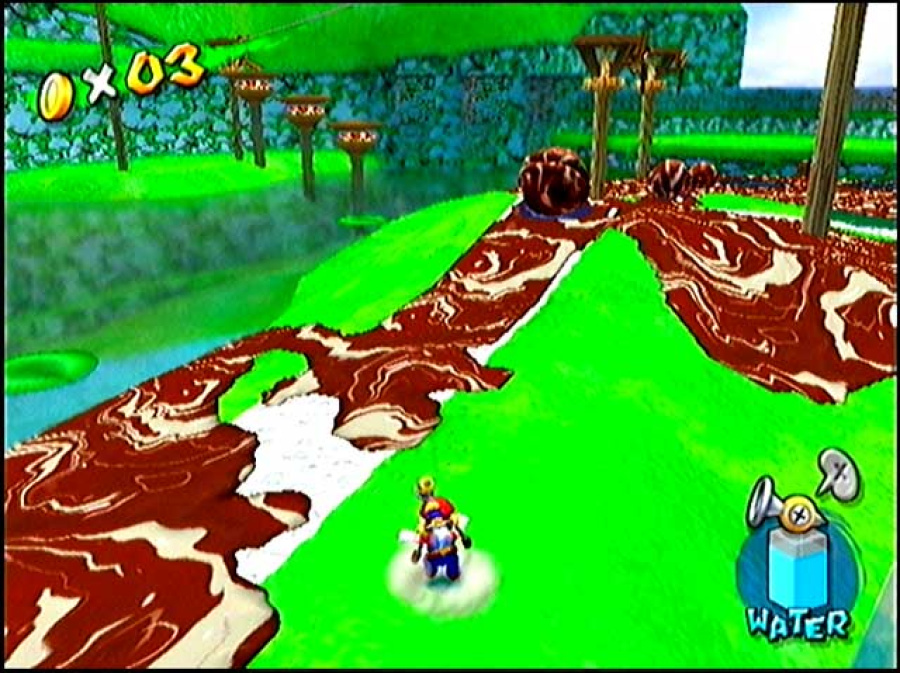
- Atmosphere: Isle Delfino remains one of Mario’s strongest settings — bright, cohesive, and full of personality.
- Mechanical identity: F.L.U.D.D. changes movement, combat, traversal, and puzzle design in ways no other Mario game quite repeats.
- Cult-classic appeal: secret stages, tropical mood, and strange mission design make it divisive but memorable.
- Historical weight: it was Nintendo’s bold GameCube follow-up to Super Mario 64 and one of the series’ most experimental 3D turns.
“Messy, brilliant, awkward, unforgettable.”
Sunshine is not the safest 3D Mario — and that is a big part of why people still argue about it.
Mario’s Most Distinct 3D Vacation
Super Mario Sunshine does not feel like a cautious sequel. It feels like Nintendo asking how far it can bend the identity of 3D Mario without breaking it. The answer is a strange and fascinating game: cleaner missions, dirtier surfaces, a more narrative setup, a tropical hub world with real place-sense, and a water-powered tool that changes nearly every interaction. It is less universally polished than some of Mario’s greatest peaks, but it is also one of the series’ strongest examples of personality over perfection.
Game Data
| Title | Super Mario Sunshine |
| Release Year | 2002 |
| Developer | Nintendo EAD |
| Publisher | Nintendo |
| Platform | Nintendo GameCube |
| Genre | 3D platformer / action-adventure |
| Players | 1 player |
| Original Format | MiniDVD disc |
| Core Loop | Clean, explore, collect, unlock, improvise |
F.L.U.D.D.-based movement, Shine Sprite hunting, episode mission structure, hub-world exploration, secret obstacle stages, and cleanup-driven progression.
Mario, Peach, and company arrive on Isle Delfino for a holiday, only to find the island polluted and Mario framed by Shadow Mario. To clear his name, Mario must restore the island’s Shine and track down the real culprit.
F.L.U.D.D. is Sunshine’s defining twist: part mobility tool, part weapon, part puzzle device, and the reason the game feels unlike any other 3D Mario.
Review / The Brilliant and Awkward Mario Experiment
The first thing Super Mario Sunshine gets right is identity. Before the player has even adjusted to the controls, the game has already announced itself as hotter, brighter, stranger, and more location-specific than nearly any Mario before it. Isle Delfino feels less like a menu of levels and more like a real place. There is a harbor, a plaza, a beach resort logic, a sense of sunshine, water, and tourism. That alone gives Sunshine an emotional hook that is very different from the abstract castle-and-portal structure of Super Mario 64.
F.L.U.D.D. CHANGES THE FEEL OF MARIOSunshine’s biggest gamble is F.L.U.D.D., and it mostly pays off. The Hover Nozzle softens platforming in one moment and opens new movement expression in the next. Spraying enemies, washing walls, hovering across gaps, riding momentum, and using different nozzles gives Mario a tool-driven rhythm that no other mainline 3D entry quite matches. It makes the game feel more mechanical and improvisational at the same time. When Sunshine clicks, it feels wonderfully alive.
ISLE DELFINO AS A PLAY SPACEDelfino Plaza is still one of the best hub worlds Nintendo has ever built because it is both readable and teasing. You learn routes across rooftops, hidden coins, nozzle locations, sewer paths, and little bits of environmental logic. The stages beyond it keep that same sense of place. Bianco Hills, Ricco Harbor, Gelato Beach, Sirena Beach, and Pianta Village all feel like distinct corners of the same holiday world. That unity matters. It gives the whole adventure a mood that stays in memory long after individual mission details fade.
WHERE SUNSHINE FIGHTS ITSELFSunshine is beloved partly because it is not perfectly smoothed out. Some missions are terrific; some are annoying. Blue Coin hunting can become a scavenger chore. Secret stages can abruptly demand much tighter platforming than the game’s broader mood suggests. The camera and some mission logic occasionally resist the player rather than challenge them cleanly. In other words, Sunshine is not immaculate. But that imperfection is wrapped around a game with such a strong personality that many players forgive the rough edges more readily than they would in a safer title.
FINAL VERDICTSuper Mario Sunshine is one of the most divisive major Mario games for good reason: it is both less consistent and more distinctive than many of its siblings. But when judged as an experience rather than a checklist of flaws, it remains one of Nintendo’s most memorable 3D adventures. It is tropical, mechanical, moody, playful, weird, and still completely worth revisiting. Not the cleanest Mario masterpiece — but absolutely one of the most interesting.
Why Historically Important
Super Mario Sunshine matters historically because it is Nintendo refusing to make the obvious sequel. After Super Mario 64, the easiest move would have been to offer a bigger, smoother version of the same design language. Sunshine instead pushes in a more thematic and tool-based direction. It gives Mario a defined vacation setting, adds a strong narrative premise, and uses F.L.U.D.D. to reshape movement and problem-solving. That makes it one of the earliest examples of Nintendo letting a flagship series take a real stylistic risk in 3D.
It was also a major GameCube statement piece. The water effects, tropical lighting, and wide-open seaside spaces helped show off the console’s capabilities in a way that felt different from the darker or more metallic mascots-and-machines style common in the early 2000s. Sunshine gave Nintendo’s hardware a colorful, playful identity while still feeling technologically ambitious.
Even now, Sunshine remains important because it shows that experimentation inside a major franchise can create long-term attachment, even when the result is not universally agreed upon. Players still debate it because it tries something specific. That alone gives it a different kind of legacy from games that are easier to praise but harder to remember.
Timeline / Key Milestones
Super Mario Sunshine debuts in Japan and immediately marks a dramatic tonal shift from Super Mario 64 with its tropical setting and F.L.U.D.D.-driven gameplay.
The GameCube gets its signature Mario showcase in North America and Europe, firmly tying Sunshine to the system’s identity.
Sunshine becomes one of the most discussed and replayed GameCube-era Nintendo titles — admired for its atmosphere, argued over for its rougher edges.
Super Mario 3D All-Stars brings Sunshine to Nintendo Switch in HD, reintroducing Isle Delfino to a large modern audience.
Nintendo lists Super Mario Sunshine as an upcoming title for Nintendo GameCube – Nintendo Classics on Switch 2, keeping the game in active circulation as part of Mario history.
Where to Play / Collect Today
Switch 2 GameCube Classics
Nintendo currently lists Super Mario Sunshine as an upcoming Nintendo GameCube – Nintendo Classics title for Switch 2 through Nintendo Switch Online + Expansion Pack.
MODERN OPTIONSuper Mario 3D All-Stars
If you already own Super Mario 3D All-Stars on Switch, Sunshine remains one of the collection’s biggest draws and an easy way to revisit the game in HD.
SEE VERSIONOriginal GameCube hardware
For the authentic 2002 feel — analogue triggers, native controller layout, and pure GameCube atmosphere — the original console is still the collector’s route.
COLLECTOR ROUTE