- Instant identity: horror-movie parody, suburban maps, and rescue panic make it readable within seconds.
- Co-op magic: few 16-bit games turn shared confusion, route planning, and last-second saves into such memorable couch play.
- Mechanical tension: every neighbor matters, every weapon pickup matters, and every wrong turn can wreck a run.
- Cult legacy: it became one of the defining “why doesn’t anything else feel like this?” games of the 1990s.
“A horror comedy, a co-op panic machine, and a 16-bit all-timer.”
Not just nostalgic — still strange, funny, stressful, and wonderfully specific.
Suburban Rescue Horror, LucasArts Style
Zombies Ate My Neighbors feels like somebody took every late-night creature feature they loved, dumped it into a suburban toybox, and then built a rescue-action game around pure escalating panic. You are not just blasting monsters. You are trying to save neighbors before they vanish, disappear into pools, get swarmed in backyards, or get shredded while you are stuck on the wrong side of a hedge. That rescue pressure is the secret ingredient. It turns every level into a little disaster-management story.
Game Data
| Title | Zombies Ate My Neighbors |
| Release Year | 1993 |
| Developer | LucasArts |
| Publisher | Konami |
| Platform | Super Nintendo / Sega Genesis |
| Genre | Top-down run-and-gun / action shooter |
| Players | 1–2 players local co-op |
| Original Format | Cartridge |
| Protagonists | Zeke and Julie |
| Core Loop | Rescue, improvise, survive, escape |
Neighbor rescue, map sweep routing, monster crowd control, key hunting, weird weapon management, bonus-level discovery, and constant movement under pressure.
Zeke and Julie discover their neighborhood overrun by monsters from practically every campy horror film imaginable. Their job is simple and chaotic: save the civilians, survive the madness, and push through level after level of suburban apocalypse.
Its 55 horror-filled levels and bizarre weapon lineup — from water guns and exploding soda to bazookas and weed-whackers — are a huge part of why the game remains so memorable.
Review / Why It Still Feels So Good
What still makes the game pop is how quickly it communicates danger. You start in a neighborhood, but it does not feel safe for even a second. The map is readable, yet every hedge, pool, fence, and cul-de-sac becomes a source of anxiety because your real objective is not merely survival. It is rescue. If you linger too long, neighbors die. If you take the wrong route, neighbors die. If your partner wanders off and attracts the wrong monster, neighbors die. That emotional pressure gives the game far more character than a standard top-down shooter.
WHY THE RESCUE MECHANIC IS BRILLIANTMost action games ask you to clear a space. Zombies Ate My Neighbors asks you to protect it while moving through it. That one shift changes everything. The monsters are not just obstacles; they are threats to a network of targets scattered across the stage. Suddenly your route matters, your priorities matter, and your split-second decisions matter. It is a design trick so elegant that it still feels fresh.
WEAPONS, TONE, AND VARIETYThe game’s tone is just as important as its rules. The reason it never feels oppressively grim is that it commits fully to camp. The monsters are silly and threatening at the same time. The arsenal is ridiculous in the best way. The level names are half joke, half promise. And the pacing keeps folding in new situations before the current joke wears out. Few games balance comedy and tension this well.
CO-OP IS WHERE THE LEGEND REALLY LIVESSolo play is strong, but co-op is why the game became beloved. Two players create a constant stream of micro-dramas: one player grabs the victim, the other gets trapped; one player finds a shortcut, the other accidentally wakes up a new disaster. That shared improvisation is why the game remains such a vivid memory machine. You do not just remember the levels. You remember the saves, the failures, and the arguments.
FINAL VERDICTZombies Ate My Neighbors is one of those rare games whose cult reputation is fully deserved. It has a real mechanical hook, a tone no one quite copied correctly, and a cooperative rhythm that still feels alive. It is funny, stressful, inventive, and full of personality. That is why it survives so well outside pure nostalgia.
Why Historically Important
Zombies Ate My Neighbors matters because it sits in a very unusual corner of 16-bit history. It is not just another licensed-looking action game, not just another co-op shooter, and not just another horror parody. It combines all three into something with a remarkably distinct identity. LucasArts is usually remembered for adventure games, but this title proved the studio could build an action game with just as much wit and personality.
It also mattered as an example of tone done right. Many games can reference horror films. Far fewer can translate that influence into mechanics, pacing, enemy variety, stage names, weapons, and atmosphere without collapsing into gimmick. Zombies Ate My Neighbors succeeds because its camp presentation is not decoration; it is fused directly into how the game plays.
Finally, its cult survival tells its own story. The game returned through Wii Virtual Console and then again in the 2021 preservation bundle because people never really forgot it. That staying power is historical evidence in itself. This is not merely a fondly remembered oddity. It is a genuine 16-bit touchstone for co-op design, horror-comedy tone, and weirdly elegant arcade pressure.
Timeline / Key Milestones
Zombies Ate My Neighbors releases on Super Nintendo and Genesis, establishing Zeke and Julie as the stars of one of the era’s strangest and best co-op action games.
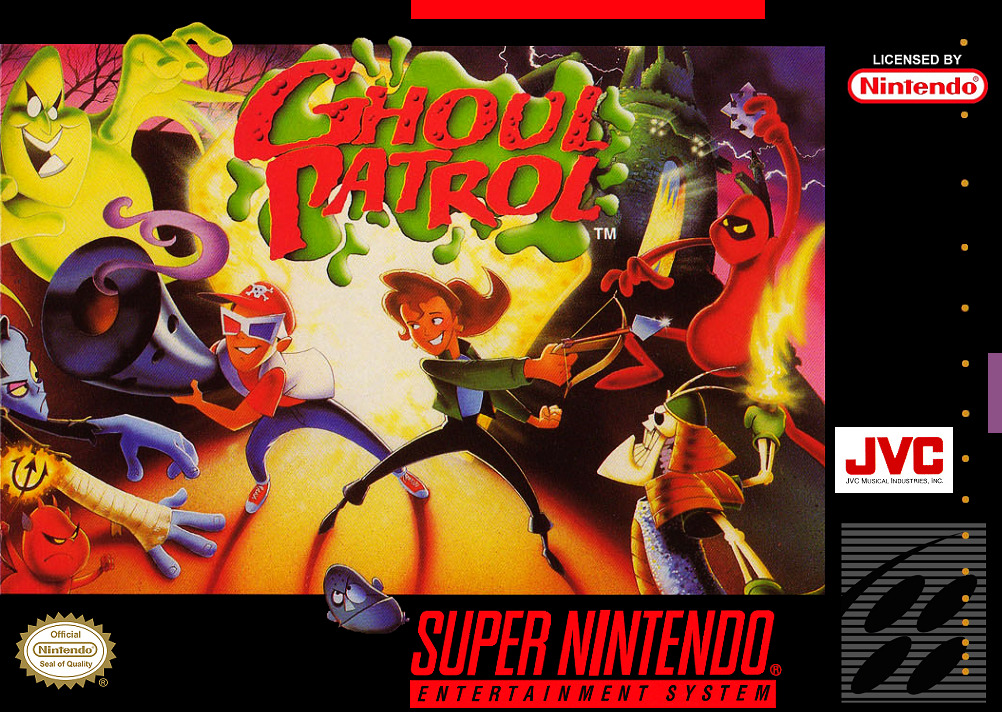
Ghoul Patrol arrives as a follow-up, confirming that the original had already carved out enough identity to become a small LucasArts horror-action line.
The game reappears digitally on Wii, helping a new generation rediscover why retro players would not stop talking about it.
Zombies Ate My Neighbors and Ghoul Patrol launches on Switch, PlayStation 4, Xbox One, and PC with save features, museum extras, interviews, and local co-op.
It stands as one of the most beloved 16-bit cult games — the kind people bring up whenever the topic is “games nobody has really replaced.”
Where to Play / Collect Today
2021 modern bundle
The simplest route is Zombies Ate My Neighbors and Ghoul Patrol on Switch, PS4, Xbox One, or PC, where the classic is preserved with quick save and museum extras.
MODERN OPTIONSNES / Genesis on CRT
For the truest period texture, the original cartridge on real hardware still gives the game its proper 16-bit snap, local co-op feel, and couch-night personality.
ORIGINAL ROUTEOriginal boxed copies
CIB SNES and Genesis editions remain the most desirable shelf artifacts, especially because the cover art is such an important part of the game’s cult identity.
COLLECT TODAY