Arcade Culture — The Neon Museum Edition
A museum-style overview of the arcade era: how cabinets became public instruments, why certain machines defined entire generations, and how arcades shifted from tech advantage to culture advantage to experience advantage. Every key cabinet includes a full Read Article deep dive.
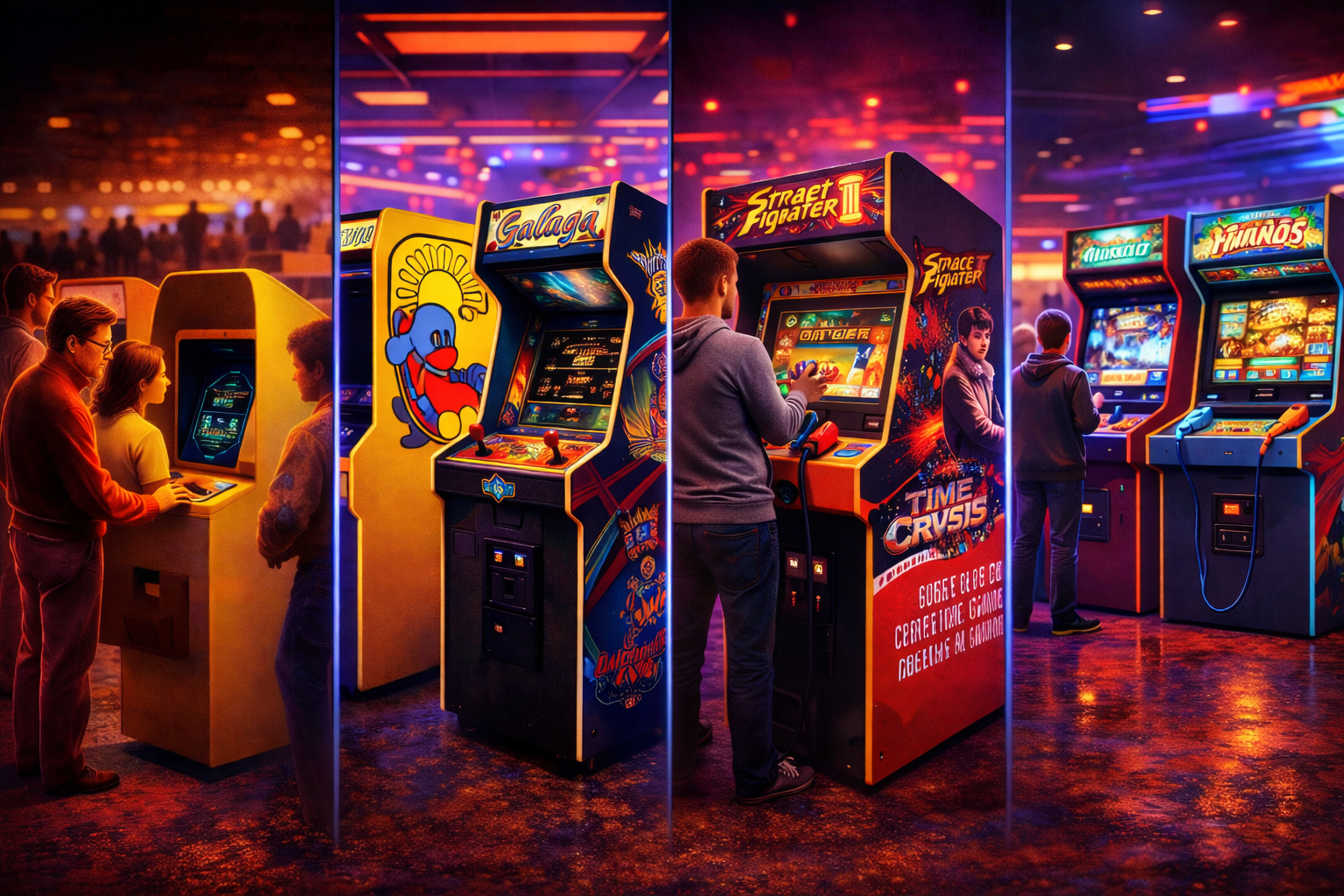
Milestones Timeline
Click a milestone to load the spotlight. Each one includes more context and direct internal links to related pages, so the timeline acts as both a history overview and a traffic funnel.
1971 — Video coin-ops appear
Before arcades became destinations, coin-op video games had to solve a brutal problem: how do you convince a stranger in a public place to understand the machine fast enough to pay? This early phase is less about mass success and more about discovering the grammar of public play: visible goals, readable danger, short attempts, and the promise that skill can be learned in front of others.
1972 — Pong ignites the floor
Pong wins because it removes friction. From across the room, anyone can tell what is happening, why a point was scored, and whether a player is in control. That clarity turns the cabinet into a social magnet: people gather, learn by watching, and want revenge almost immediately. It is one of the purest expressions of arcade design as public theatre.
1978 — Space Invaders shockwave
Space Invaders pushes arcade culture into mass visibility. The machine creates pressure the room can feel, and the scoreboard turns success into reputation. Now the cabinet is not just something you play — it is something you defend. Initials on a screen become proof of mastery, and arcades begin to feel like places where local legends are made one coin at a time.
1980 — Pac-Man goes pop culture
Pac-Man proves that a cabinet can be more than a challenge machine — it can be a recognizable cultural icon. Character identity, sound design, cabinet art, and immediate readability fuse into something broader than gameplay. This is a major shift: arcades are no longer defined only by skill and novelty, but by personality and mass appeal.
1991 — Fighting games become stadiums
Street Fighter II transforms the arcade from a room of machines into a room of spectators. Crowds form naturally because the drama is readable, the rivalry is immediate, and the social stakes are huge. Players are no longer only chasing scores — they are defending identity, style, match-up knowledge, and local status. This is the clearest bridge from arcade culture to modern esports culture.
1994–1995 — Experience cabinets fight back
As home systems get stronger, arcades pivot from pure technical superiority to physical superiority. Wheels, linked cabinets, pedals, guns, seats, and giant enclosures let arcades offer something the living room cannot: spectacle as hardware. The machine itself becomes part of the show, and the venue becomes part of the game.
2000s — The slow fade (outside strongholds)
Arcades do not disappear in one dramatic collapse. Instead, they are slowly squeezed: home libraries grow, online play replaces local matchmaking, and convenience wins more and more often. In many regions, the default place to compete shifts from the public hall to the private room. The arcade loses scale — but not its cultural fingerprints.
2010s — Arcade becomes a venue experience
The arcade survives by becoming intentional again. Barcades, curated retro floors, specialty venues, rhythm-game strongholds, tournaments, and nostalgia-driven spaces all lean into what home cannot copy well: atmosphere, presence, and shared energy. Arcades are no longer the default place to play — but they become a memorable place to go.
2020s+ — Preservation & revival pockets
Today, the arcade survives through restoration, preservation, and community stewardship. The old halls may be rarer, but their ideas are everywhere: leaderboards, spectatorship, local meetups, public status, and games designed to be understood in motion. The cabinet is no longer always the center — but arcade DNA still shapes how games are watched, shared, and celebrated.
Cabinet Hall — The Machines With Charisma
These aren’t just games — they’re machines designed for a crowd. The hall starts with a curated featured selection, while the broader archive stays folded until the visitor wants more. That keeps the page elegant and still lets you funnel visitors into detail pages and Read Article deep dives.
1971 • Pioneer Prototype dream
1980 • Icon Character brand
1991 • Fighter Crowd arena
1972 • Classic Duel design
1978 • Shooter Score identity
1979 • Vector Pure control
1981 • Shooter Hardcore cabinet
1981 • Platform Stage drama
1981 • Shooter Score craft
1994 • Experience Linked seats
1995 • Experience Cover pedal
Why the Lights Slowly Went Out — And What Survived
Arcades rarely died in a single dramatic moment. In most regions, the glow faded slowly as the home console, the personal computer, and later the online world took over more of the jobs arcade halls once did better than anyone else.
Classic arcade halls were built on advantage. In the 1970s and early 1980s, they had the better machines. The screens were brighter, the cabinets were stranger, and the games often existed there first. Going to the arcade meant accessing a level of technology most homes simply could not match.
That advantage weakened once living rooms improved. Consoles became powerful enough to deliver longer games, bigger worlds, and stronger franchises. At the same time, home play had a practical advantage arcades could never beat: you did not have to leave the house, wait for a turn, or keep feeding coins into the machine. Convenience began to beat spectacle more and more often.
Then the social equation changed. Arcades had once been the easiest place to find rivals, spectators, and local legends. But once online multiplayer, matchmaking, leaderboards, and voice chat moved into the connected home, many halls lost one of their strongest reasons to exist. The arcade was no longer the default meeting place for competitive play.
This did not produce one clean collapse. Instead, the old halls faded unevenly. Some vanished. Some reinvented themselves as redemption centers. Some leaned into experience cabinets, dance games, driving rigs, or light-gun attractions. Others survived as retro sanctuaries, tournament venues, or regional strongholds where the public room still mattered.
Yet the culture itself never truly disappeared. The arcade’s greatest invention was not only the cabinet, but the idea of watchable skill: gameplay strangers can understand at a glance, mastery that becomes public status, and competition that creates stories in real time. That logic survived the hall.
Today you can still feel arcade DNA in esports arenas, speedrun marathons, rhythm-game communities, barcades, preservation projects, retro exhibitions, and modern games built to be exciting even for people who are only watching. The old neon rooms may be rarer — but their design language still travels.