The History of Video Game Consoles — Living Room Revolution
A museum-style journey through the rise of the home console: how dedicated machines moved gaming from laboratories and arcades into the living room, how platform holders turned hardware into ecosystems, and why each generation changed not only technology, but also the way people bought, shared, and remembered games.
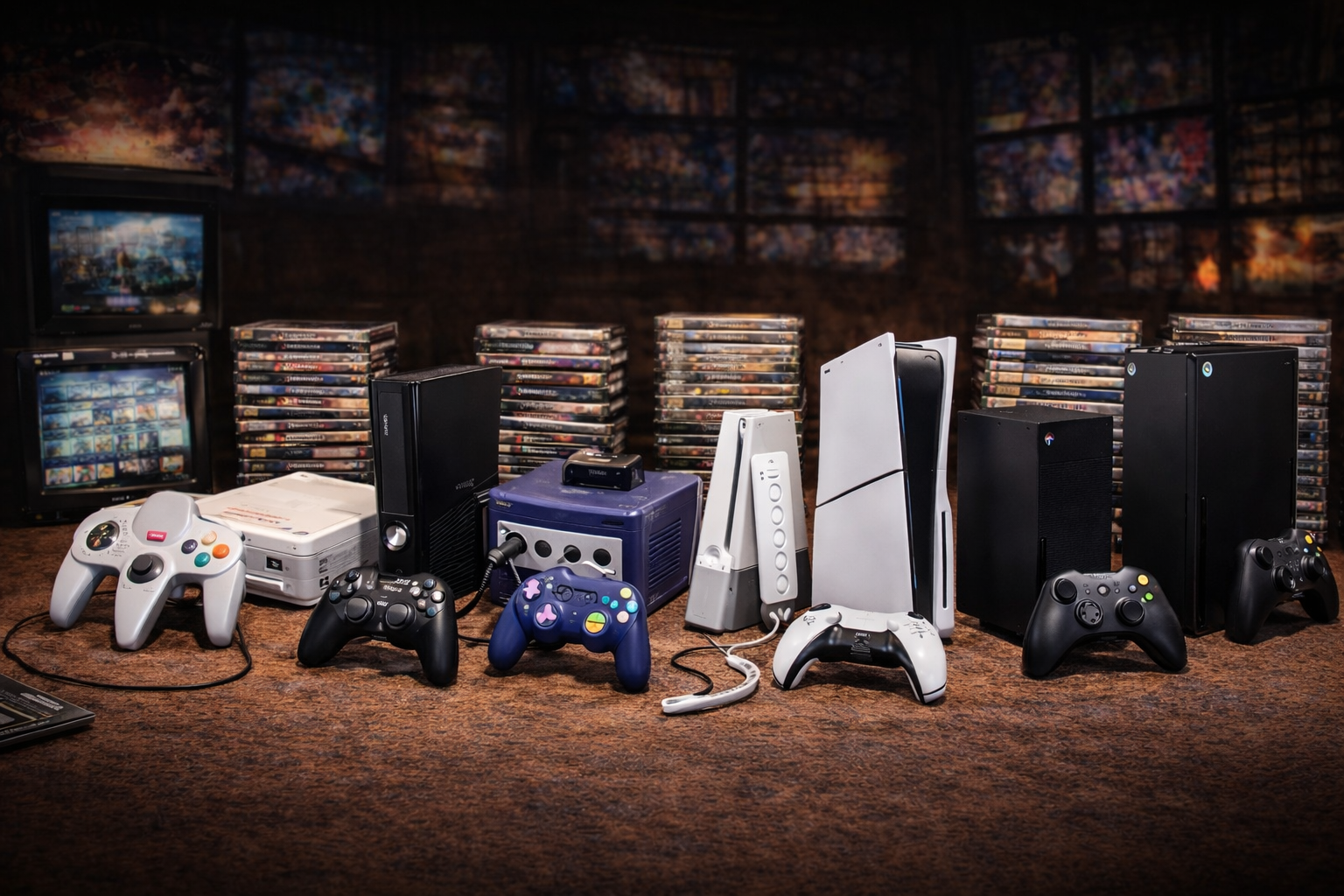
From TV Attachment to Cultural Infrastructure
Consoles began as experimental entertainment devices attached to televisions. Over time they became family machines, status symbols, Christmas miracles, teenage battlegrounds, online gateways, media hubs, and eventually long-term digital platforms. The console did not simply bring games home — it redefined what “home gaming” could be.
Milestones Timeline — How Consoles Took Over the Living Room
This timeline tracks the major turning points: the first home experiments, the cartridge era, the crash, the Nintendo recovery, the 3D and CD revolution, the online shift, the motion era, and the rise of consoles as service ecosystems. Each spotlight connects hardware changes to broader market and cultural consequences.
Console Hall — The Machines That Changed Home Gaming
These are not just successful boxes under televisions. They are the machines that changed expectations: how games were sold, how controllers felt, how families played together, and how entire generations remember childhood, competition, and technological wonder.
Console Wars — When Hardware Became Identity
Consoles were never only technical products. They became tribes, mascots, ad campaigns, playground arguments, retail battles, and declarations of taste. The “console war” was partly about chips and media — but even more about identity, brand confidence, and who seemed to own the future.
One of the great myths of console history is that the biggest victories were won by raw technical power alone. In reality, platform leadership usually came from a mix of price, trust, timing, software libraries, and a convincing public story about why this machine belonged in your home.
Nintendo and Sega turned platform competition into personality. Sony turned the console into an aspirational cultural object. Microsoft turned services and infrastructure into strategic weapons. In every era, the winner was rarely the company with only the strongest hardware spec sheet. The winner was the one that best aligned the machine, the message, and the software.
Controller Evolution — How Hands Learned New Worlds
Console history is also controller history. Each major shift in play had to be translated into the hand: paddles for direct physical motion, the D-pad for 2D precision, analog sticks for 3D movement, motion controls for broad accessibility, and hybrid modular input for modern flexibility.
Direct physical control
Early home systems borrowed arcade logic: turning a knob felt immediate, visible, and intuitive.
2D precision becomes standard
The directional pad made compact, precise movement possible and became one of the most important controller inventions ever.
3D needs new language
Once worlds became spatial, controllers needed nuance — analog sticks made movement feel continuous instead of binary.
Camera and body separate
Modern 3D play stabilized when one hand moved the character and the other managed the point of view.
Play broadens beyond experts
Motion control lowered some barriers and changed what counted as a “player” inside the home.
Portable, modular, adaptive
Modern controllers balance comfort, mobility, detachment, docking, and shared local play.
From Console Generations to Platform Ecosystems
The old model was easy to explain: buy a new box every generation and start over. The newer model is messier but more powerful: maintain accounts, libraries, subscriptions, cloud saves, digital storefronts, patches, and long-term platform identity.
For decades, console history was told in neat chapters: the next generation arrives, the old one fades, and consumers migrate forward. That structure still exists, but it no longer explains everything. Modern consoles are also accounts, services, libraries, and social graphs.
This changes the emotional logic of hardware. A new machine is no longer only a new start. It is also a continuation: your purchases, friends, achievements, subscriptions, and identity often travel with you. In that sense, the modern console behaves less like a toy generation and more like an evolving digital habitat.