The Console That Made Speed Feel Generational Again
The PlayStation 5 is historically important because it framed a new generation around responsiveness rather than only around polygon counts. Sony’s message was not simply that games would look better. It was that loading would collapse, worlds would stream faster, transitions would feel immediate, and the controller itself would carry more physical sensation than before. The result was a console that sold power, yes — but even more importantly sold a different rhythm of play.
Hardware Data / Technical Snapshot
| Name | Sony PlayStation 5 |
| Launch Window | Released November 12 / November 19, 2020 depending on region |
| Manufacturer | Sony Interactive Entertainment |
| Variants | Standard PS5 with Ultra HD Blu-ray disc drive / PS5 Digital Edition without disc drive |
| CPU | x86-64 AMD Ryzen “Zen 2” • 8 Cores / 16 Threads • up to 3.5 GHz variable |
| GPU | AMD Radeon RDNA 2-based graphics engine • up to 2.23 GHz • 10.3 TFLOPS |
| System Memory | 16 GB GDDR6 • 448 GB/s bandwidth |
| Internal Storage | 825 GB custom SSD |
| Storage Throughput | 5.5 GB/s raw read bandwidth |
| Media | Ultra HD Blu-ray, Blu-ray, DVD |
| Networking | Ethernet, IEEE 802.11 a/b/g/n/ac/ax, Bluetooth 5.1 |
| Video Out | Support for 4K 120Hz TVs, 8K TVs, and VRR via HDMI 2.1 |
| Audio | “Tempest” 3D AudioTech |
| Input / Output | USB Type-A Hi-Speed, USB Type-A Super-Speed 10Gbps ×2, USB Type-C Super-Speed 10Gbps |
| Dimensions | Approx. 390 × 104 × 260 mm standard disc model |
| Weight | Approx. 4.5 kg standard disc model |
| Power Consumption | Approx. 350 W standard disc model |
| Controller | DualSense wireless controller |
| Class | Ninth-generation home console |
Build a machine that looks unmistakably “next generation,” but make the deeper claim that storage, streaming, and controller feel are as transformative as raw graphics power.
The PS5 made speed visible to ordinary players. Load times, quick transitions, tactile feedback, and audio presence all combined into a platform identity people could feel immediately.
Its bold shell divided opinion, and its early years were shaped as much by supply constraints and cross-generation overlap as by the machine’s own design ambitions.
Platform Legacy / Why PS5 Was More Than Just “PS4, But Stronger”
The PlayStation 5 matters because it tried to define a generation around a full stack of sensation rather than only a bigger graphics number. Sony pushed visual upgrades, of course, but the deeper museum story is architectural and experiential: ultra-fast storage, controller resistance, richer haptics, 3D audio language, and a system design built around immediacy.
For a hardware archive, that matters immensely. Some consoles are important because they dominate a market. Others are important because they shift what users expect from the category itself. The PS5 belongs to that second group: it helped normalize the idea that loading, streaming, tactile response, and audio presence are central console features rather than side notes.
What Made The PS5 Feel Like A Break Instead Of A Routine Upgrade
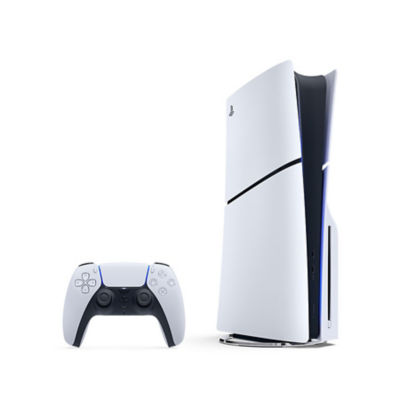
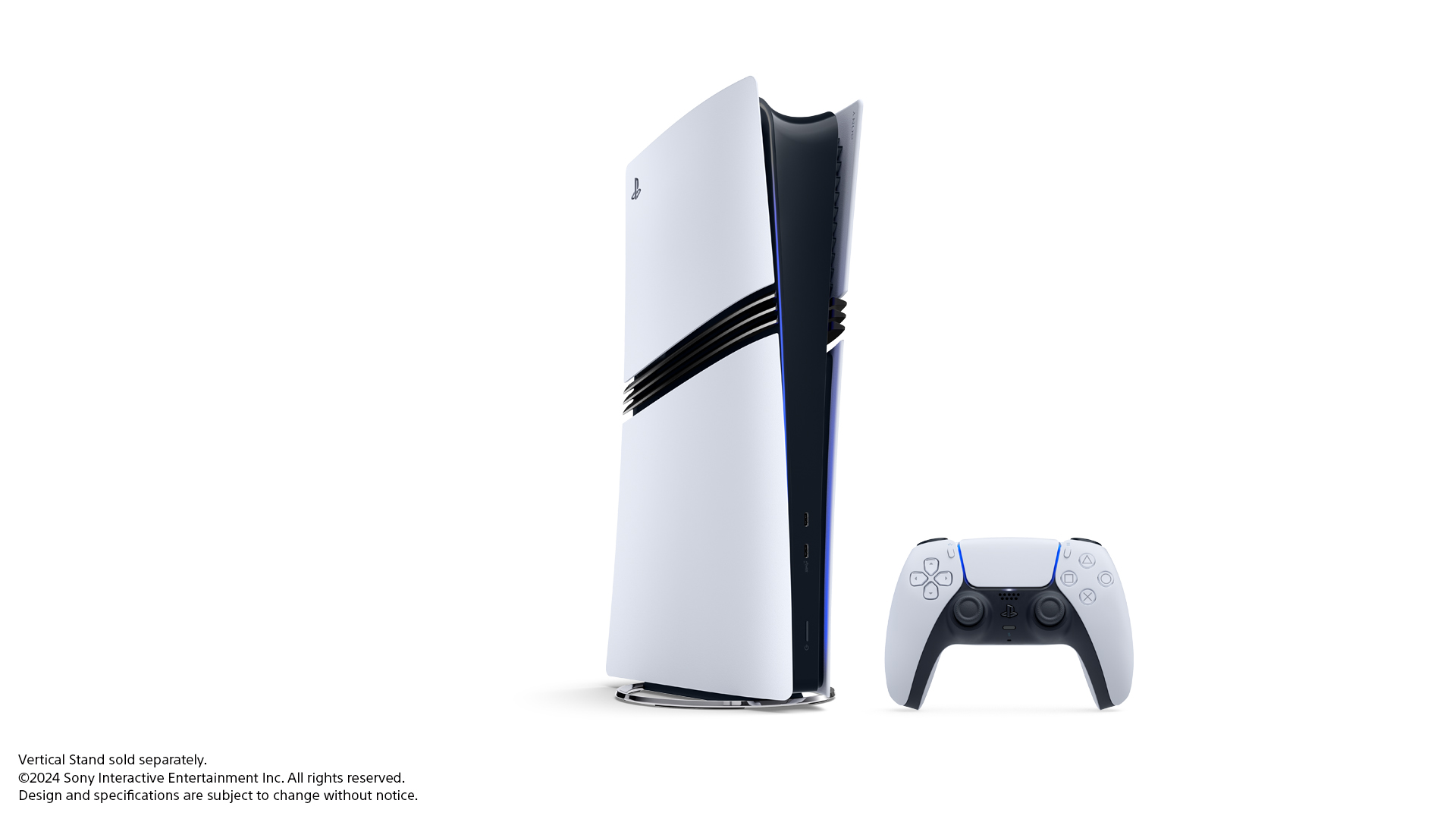
Sony revealed the PS5 as an object that wanted to look unlike the PS4 generation. Tall, white, curved, and almost architectural, the shell projected distance from the flat black conservatism of the previous era. Even before discussing specs, the machine signaled that Sony wanted a visual and emotional reset.
WHY THE SSD WAS THE REAL STORYGenerational marketing often defaults to graphics, but the museum value of PS5 lies in its storage narrative. Sony treated its custom SSD as the heart of the system, arguing that streaming speed and quick loading would reshape design itself. That mattered because it shifted player expectations. Waiting began to feel old-fashioned in a new way.
DUALSENSE AS HARDWARE IDENTITYThe DualSense controller is central to understanding PS5. Haptics and adaptive triggers were not presented as optional flourishes. They were part of the platform’s self-definition. Sony wanted the new generation to feel different in the hands, not merely on the screen.
DISC AND DIGITAL AS A GENERATIONAL PAIRThe launch of both a standard PS5 and a Digital Edition told an important cultural story. Physical media was still central to the flagship identity, but Sony also acknowledged the accelerating legitimacy of fully digital console ownership. The PS5 family therefore captured a transition moment as much as a technical one.
THE PS5 AS PLATFORM RECENTERINGIn hindsight, the PlayStation 5 can be read as Sony’s effort to recenter the console around immediacy and immersion. It was a machine designed to feel decisive: less waiting, more sensory feedback, more architectural confidence, and a much clearer statement that the new generation should feel different even in small moments.
Why Historically Important
The PlayStation 5 is historically important because it helped redefine what a “next-generation” console upgrade could mean.
Instead of selling the future only as sharper graphics, Sony sold it as a combination of ultra-fast storage, tighter world streaming, tactile control feedback, and an audio-visual presentation built around presence and immediacy.
For a hardware museum, the PS5 is therefore more than a successful console. It is a hinge machine between the older era of waiting-heavy disc-and-install console culture and a new baseline where speed, immersion, and controller feel became central parts of the platform promise.
Timeline / Key Milestones
Sony publicly details the PS5 hardware architecture and makes the custom SSD, not just graphics power, central to the platform’s identity.
Sony confirms two launch models — standard PS5 and PS5 Digital Edition — and frames the new generation as both physical-media flagship and digital transition point.
The PlayStation 5 launches first in selected territories, turning Sony’s SSD-first and DualSense-led vision into a real consumer platform.
The launch widens to Europe and many other territories, establishing PS5 as the next mainline PlayStation platform worldwide.
Sony introduces the smaller PS5 model, turning the original launch statement into a more compact long-tail retail platform.
The PS5 Pro extends the family into a premium performance tier, confirming the PS5 generation as a scalable platform rather than a single fixed box.
The PS5 stands as one of the most important consoles of the SSD era — a machine remembered not only for power, but for changing how fast and how physical console play could feel.
Why A Hardware Museum Needs A PS5 On Display
The SSD becomes the story
Few consoles communicate the architectural meaning of fast storage as clearly as the PS5.
SSD VIEWDualSense changed the feel
The controller is part of the artifact here. PS5 is one of the clearest cases where the pad itself carried the generational message.
CONTROL VIEWImpossible to mistake for PS4
The console’s shell made sure the generation looked different from across the room, not only in a spec sheet.
DESIGN VIEW4NERDS Collector Marketplace
A curated access point for PlayStation 5 collectors and players: launch models, Digital Edition units, boxed systems, DualSense controllers, charging docks, SSD upgrades, headsets, stands and modern PS5-era setup gear — clearly marked as partner links where applicable.
Shop PS5 listings
Browse current eBay listings for PlayStation 5 consoles, boxed launch models, Digital Edition units, DualSense controllers, game bundles, stands, accessories and collector-ready hardware sets.
- Best source for used systems, bundles and boxed launch hardware
- Useful for DualSense variants, stands and PS5 accessories
- Strong for auction pricing, regional availability and condition-based deals
Browse PS5 gear
Explore Amazon for PlayStation 5 systems, DualSense controllers, charging docks, SSD storage, HDMI 2.1 cables, headset options, cooling stands, media remotes and everyday PS5 setup accessories.
- Good for new accessories, storage upgrades and setup gear
- Useful for charging docks, cables, controllers and media accessories
- Complements eBay when you want retail-style convenience
Curated Etsy picks coming soon
Planned for handmade PlayStation shelf labels, acrylic display plaques, controller stands, console-room decor, neon-style wall art and premium setup pieces for modern PlayStation collections.
- Handmade display pieces and collector-room decor
- Potential shelf labels, plaques and console artwork
- Added once the Etsy setup is ready