- Presentation leap: Mario Kart had never looked this fluid, rich, or expensive before.
- Track quality: Mount Wario, Sunshine Airport, Electrodrome, Cloudtop Cruise, and Rainbow Road remain elite series material.
- Mechanical clarity: anti-gravity adds spectacle and flow without making the series harder to understand.
- Historical weight: this is the Wii U game that helped define the platform’s best-case version of Nintendo polish.
“A rescue mission for the Wii U — and a high point for Mario Kart.”
Mario Kart 8 is both a beautiful racer and a major turning point in Nintendo’s modern multiplayer identity.
The Wii U Showcase That Reframed the Series
Mario Kart 8 feels like the moment the series fully understood how elegant it could look in HD. Previous entries had speed, chaos, and charm. This one adds a kind of visual and structural confidence that immediately changes the tone. Tracks are not just courses now — they are set pieces, vistas, and grand theme-park architecture. The result is one of the most luxurious-feeling Nintendo games of its era.
Game Data
| Title | Mario Kart 8 |
| Release Year | 2014 |
| Developer | Nintendo EAD |
| Publisher | Nintendo |
| Platform | Wii U |
| Genre | Kart racing |
| Players | 1–4 local / up to 12 online at launch |
| Course Count | 32 base courses across 8 cups |
| Later Additions | 16 DLC courses and 200cc update |
| Original Format | Disc / Nintendo eShop |
| Core Loop | Race, drift, boost, collide, improve |
Anti-gravity segments, drifting, item pressure, kart builds, returning gliding and underwater sections, HD track spectacle, and rematch-heavy multiplayer.
Anti-gravity racing, ATV handling, a gorgeous HD presentation, highlight reels via Mario Kart TV, and a DLC expansion path that gave the original version unusual long-term growth.
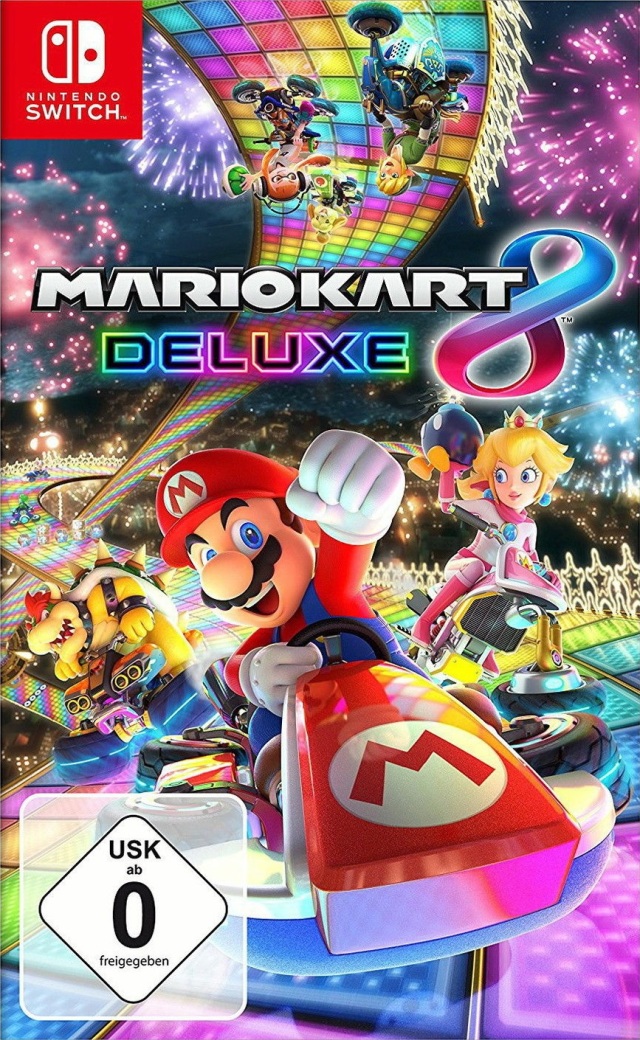
Anti-gravity is the signature new idea: racers can drive along walls and ceilings, turning track geometry into spectacle without sacrificing readability.
Review / Why It Still Feels So Complete
Mario Kart 8 feels premium the second it starts moving. The lighting, the animation, the track surfaces, the music, the camera confidence — everything announces that this is not just another sequel on autopilot. The game understands spectacle, but more importantly it knows how to make spectacle serve legibility. Even when the race is visually busy, the line is readable and the track still makes immediate sense.
ANTI-GRAVITY DONE RIGHTAnti-gravity is such a strong idea because it changes the emotional shape of a race without making the controls feel alien. Walls and ceilings become usable surfaces. Corners become theatrical. Track layouts can now twist into themselves in ways older Mario Kart games could only suggest. Yet the player rarely feels lost. That balance between novelty and readability is one of the game’s greatest design wins.
TRACKS THAT FEEL LIKE DESTINATIONSThe course lineup is exceptional. Sunshine Airport turns an airport fantasy into a race space with real momentum. Mount Wario feels like a downhill event rather than a standard loop. Electrodrome glows with nightclub energy. Cloudtop Cruise makes platforming-style sky fantasy feel natural inside a kart racer. And Rainbow Road is one of the most elegant modern interpretations of a series icon. Mario Kart 8 does not simply supply tracks — it stages them.
THE SOUND AND THE SWEEPA huge part of the game’s power comes from its music and movement. The jazz-fusion soundtrack gives the whole package an upscale feel, and the orchestration helps every race feel important. Combined with the visual sheen, it creates an unusual result: a Nintendo multiplayer game that feels both playful and prestigious at once.
WHERE THE ORIGINAL VERSION SHOWS ITS LIMITSThe original Wii U version is not completely untouchable. Its battle mode was the most obvious weak spot, because it used standard race tracks rather than fully bespoke arenas. That mattered, especially in a series with such a strong local-versus legacy. But that flaw sits beside an otherwise magnificent racer. The core driving, track design, and presentation are all so strong that the game still feels like a modern high point.
FINAL VERDICTMario Kart 8 is one of the defining Nintendo games of the 2010s. It did not just keep Mario Kart relevant; it made the series feel grander, richer, and more visually complete than ever before. Even with the later improvements of Deluxe, the original 2014 Wii U release remains historically important, aesthetically stunning, and deeply worth preserving.
Why Historically Important
Mario Kart 8 mattered because it re-established the series as a technical and artistic showcase. Earlier entries had introduced important systems, but Mario Kart 8 made the whole package feel lavish. It was one of the clearest demonstrations that Nintendo’s design strengths could scale beautifully into a high-definition presentation without losing their warmth.
It also mattered enormously for the Wii U. The console struggled for momentum, and Mario Kart 8 became one of the titles that gave it real identity and renewed attention. For many players, this was the game that justified the system or at least made its best-case promise feel real. Its success also helped produce the long tail that later fed directly into Mario Kart 8 Deluxe on Switch.
Beyond platform history, Mario Kart 8 helped normalize a more modern Mario Kart structure: refined customization, cleaner visual communication, anti-gravity spectacle, and substantial DLC expansion. It is not just a beloved entry. It is the template that the modern era of Mario Kart would build on.
Timeline / Key Milestones
Mario Kart 8 arrives on Wii U and immediately becomes one of the console’s most important system-defining releases.
The first add-on pack extends the game with new tracks, karts, and crossover material, showing that Nintendo is willing to grow Mario Kart post-launch.
The free 200cc update and the second major DLC wave push the original Wii U version into a more complete and faster final form.
Mario Kart 8 Deluxe on Switch carries the core of this game into a bigger audience, cementing the original Wii U release as the foundation of a much larger success story.
New Wii U eShop purchases become unavailable, shifting the original version firmly into collector, preservation, and already-owned digital territory.
Nintendo discontinues Wii U online services, leaving Mario Kart 8’s original version primarily as a local-play and archival experience.
4NERDS Collector Marketplace
A curated access point for players, collectors, and retro fans: original-market searches, modern related items, and future handmade display pieces — clearly marked as partner links where applicable.
Shop original Wii U copies
Browse current Mario Kart 8 offers on eBay — ideal for original Wii U discs, boxed editions, regional versions, manuals, bundles, and collector-grade finds.
- Original Wii U disc copies
- Boxed versions and regional variants
- Condition, language, and price comparison
Paid partner link / Werbung — availability and pricing depend on eBay sellers.
Browse related Mario Kart finds
Explore Amazon for Mario Kart-related books, guides, themed accessories, Nintendo-related products, and retro-inspired extras connected to the wider Mario universe.
- Books, merch, and accessories
- Gift ideas and modern products
- Broader Mario Kart-themed browsing
Paid partner link / Werbung — as an Amazon Associate, 4NERDS Gaming may earn from qualifying purchases.
Curated Etsy picks coming soon
Planned for handmade retro art, display objects, shelf pieces, prints, and museum-style collectibles that match the 4NERDS archive aesthetic.
- Wall art and display-focused pieces
- Handmade and fan-crafted style items
- Added once the setup is ready
Etsy affiliate integration will be added after the tracking setup is approved and tested.
Transparency note: 4NERDS Gaming does not sell these items directly. External shops, prices, stock, shipping terms, and seller conditions may change at any time. eBay and Amazon links in this section are sponsored / paid partner links. Etsy is currently shown as an upcoming integration and does not link out yet.