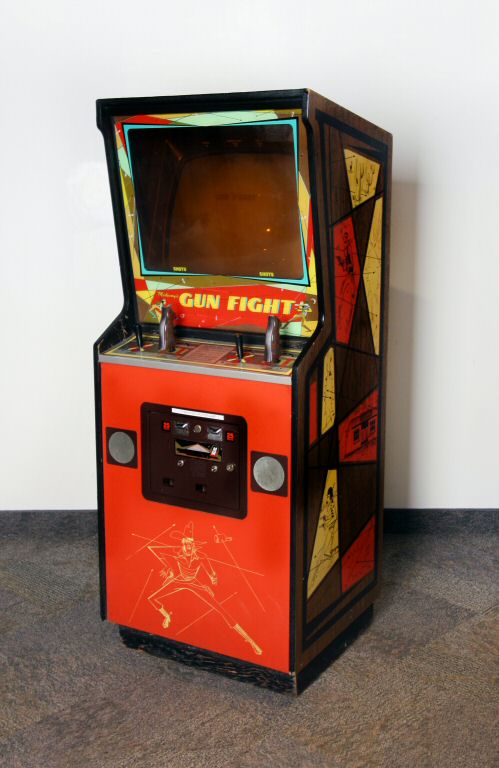
The Cowboy Duel That Changed Arcade Technology
Gun Fight matters for two reasons at once, and that dual identity is exactly what makes it such a museum-grade arcade artifact. On the surface, it is a western shootout: two players, opposing cowboys, cacti in the middle, ricocheting bullets, and a short burst of competitive tension. Underneath that, though, it represents a deeper industrial transition. Midway’s U.S. release transformed Taito’s Western Gun into one of the first truly modern-feeling arcade machines by using an Intel 8080 microprocessor, opening the door to more flexible animation, logic, and hardware reuse across the rest of the decade.
Hardware Data / Technical Snapshot
| Name | Gun Fight |
| Launch Window | November 1975 (North American Midway release) |
| Original Source | Taito’s Western Gun (1975) |
| Manufacturer | Midway Manufacturing Co. |
| Original Designer | Tomohiro Nishikado (Western Gun) |
| U.S. Hardware Adaptation | Dave Nutting Associates / Midway 8080 platform |
| CPU | Intel 8080 @ 2 MHz |
| Display | Raster monitor, 256 × 224, black-and-white with yellow overlay |
| Sound | Custom / discrete-style effects |
| Controls | Per player: movement control plus separate aiming / firing control |
| Cabinet Types | Standard upright and cocktail |
| Players | 1–2 players, simultaneous duel focus |
| Class | Early multiplayer arcade shooter / western duel cabinet |
Gun Fight turns a simple arcade premise into a mechanically rich duel by separating movement from aim and framing each round as a short, tense contest of spacing and timing.
It proved that a microprocessor could make arcade action more flexible, more dynamic, and more commercially compelling than earlier fixed-logic designs.
Seen without historical context, the visual simplicity can make it look minor — but that is exactly why a museum page needs to explain what changed beneath the screen.
Arcade Legacy / Why Gun Fight Belongs In A Bigger Lineage Story
Gun Fight is not just important as a standalone cabinet. It is a hinge between eras. Behind it stands Sega’s earlier electro-mechanical Gun Fight inspiration, then Taito’s Western Gun, then Midway’s U.S. adaptation with a microprocessor. After it comes a more confident 8080-based arcade future.
That is why this machine belongs in a museum not only as a game, but as a transition object. It bridges electro-mechanical design logic, early Japanese videogame creativity, Midway’s U.S. market power, and the technical path that would soon produce far more famous late-70s cabinets.
What Made Gun Fight Feel Like More Than A Shootout
The story begins with Taito’s Western Gun, designed in Japan in 1975. Midway then brought the concept to North America as Gun Fight, but did more than merely relabel it. The U.S. version reworked the technical foundation and, in the process, turned the game into a hardware milestone.
THE FIRST TIME PLAYERS FOUGHT EACH OTHER AS PEOPLEEarly videogame history contains plenty of abstract conflict, but Gun Fight stands out because it made violence explicitly human. Two cowboys face off directly, visible as people rather than paddles, tanks, or spaceships. That gave the duel a very different emotional grammar from the rest of the mid-70s arcade floor.
WHY THE MICROPROCESSOR MATTEREDThe biggest historical step is technical. Midway’s version is famous for replacing older TTL-style logic with an Intel 8080 microprocessor. That shift gave developers a more flexible way to handle animation, object placement, and future platform evolution. In hardware-history terms, Gun Fight is less a dead end than a launchpad.
A SMALL GAME WITH LARGE AFTERSHOCKSOne of the most interesting aftereffects is how the microprocessor-based animation impressed Taito’s Tomohiro Nishikado. The lesson mattered. It fed directly into later design thinking that would culminate in Space Invaders and the explosive rise of late-70s arcade culture.
WHY THE CABINET STILL WORKS AS AN OBJECTThe Gun Fight cabinet remains visually compelling because it sells the western fantasy hard: wood-style graphics, bright frontier imagery, duel posture, and a distinctly mechanical control panel. It still looks like a machine designed to gather a crowd and produce a short burst of tension every ninety seconds.
Why Historically Important
Gun Fight is historically important because it sits at the overlap of design history, technology history, and market history. It is one of the earliest arcade games to present direct human-versus-human combat, one of the first major Japanese-origin arcade concepts to break into the United States, and one of the clearest early demonstrations of what microprocessor-based arcade hardware could do.
That combination gives it unusual weight. Plenty of games are firsts in one category. Gun Fight matters because it is a first, or near-first, in several categories that all became central to the medium.
For a hardware museum, that makes it more than a western cabinet. It is a threshold machine — one that marks the moment arcade games stopped being merely clever fixed-logic novelties and started becoming programmable platforms with a much larger future.
Timeline / Key Milestones
Sega’s Gun Fight establishes a western duel concept in electro-mechanical form, laying down the thematic groundwork long before microprocessor arcades.
Taito releases Western Gun in Japan and Europe, introducing articulated cowboy characters, ricochets, and direct player-versus-player gunplay.
Midway launches Gun Fight in North America, rebuilding the game around Intel 8080 hardware and creating one of the first landmark CPU-driven arcade cabinets.
Gun Fight becomes one of the best-selling arcade videogames of its period and proves that the western duel concept has real U.S. coin-op appeal.
Midway follows with Boot Hill, a spiritual and mechanical successor that expands the same duel structure into a slightly more theatrical frontier presentation.
The broader hardware logic pioneered here echoes into the late-70s arcade explosion, with Space Invaders becoming the most famous cultural consequence.
Surviving cabinets now function as both playable artifacts and major teaching tools for the history of early arcade technology.
Why A Hardware Museum Needs Gun Fight On The Floor
The arcade before and after the CPU
Gun Fight lets visitors see the exact point where arcade hardware stopped being purely fixed-logic spectacle and became more programmable.
TECH VIEWA duel built on tension, not speed
Its compact rounds, separated controls, and ricochet logic make it a sharp demonstration of early competitive design discipline.
DUEL ANGLEJapan, Midway, and the U.S. market
The cabinet captures a key early exchange between Japanese design and American arcade manufacturing before the global boom fully arrived.
MARKET STORY