- Strong source material: the 2004 GBA original already had excellent stage logic and tactile movement.
- Modernized smartly: co-op, casual style, time attack, and new worlds make this more than a straight visual refresh.
- Great pacing: short levels and readable objectives make it ideal for “one more stage” play.
- Quietly important: it preserves a neglected Nintendo subseries and reconnects modern players with the Donkey Kong ’94 design lineage.
“Small puzzles, sharp movement, and remake choices that mostly respect the original.”
Not a reinvention — a careful modernization of a very particular Nintendo design style.
A Modern Return to Nintendo’s Puzzle-Platform Craft
Mario vs. Donkey Kong (2024) is one of those remakes that makes more sense the longer you look at Nintendo’s catalog. It is not reviving a blockbuster; it is reviving a design branch. The original Game Boy Advance game occupied a strange, fascinating space between arcade Donkey Kong, Donkey Kong ’94, and Mario’s movement-heavy 2D history. This remake preserves that structure — key, door, toy, timing, movement mastery — while smoothing the edges just enough for a modern audience without losing the compact cleverness that made the concept work in the first place.
Game Data
| Title | Mario vs. Donkey Kong |
| Release Year | 2024 |
| Developer | Nintendo Software Technology Corporation |
| Publisher | Nintendo |
| Platform | Nintendo Switch |
| Genre | Action / Puzzle / Puzzle-platformer |
| Players | 1–2 players local |
| Original Basis | Remake of the 2004 Game Boy Advance game |
| Level Count | Over 130 levels |
| Core Loop | Observe, route, move cleanly, rescue Mini-Marios, perfect stages |
Platforming precision, key-and-door puzzle flow, object interaction, enemy timing, Mini-Mario escort levels, and arcade-style Donkey Kong boss encounters.
Fully updated visuals and music, two-player co-op with Toad, Casual Style, Time Attack, 1-Up bonus stages, and the new worlds Merry Mini-Land and Slippery Summit.
This remake still centers Mario’s broader move set — including climbing, swinging, handstands, and backflips — which is a huge part of why the game feels more physical than a typical key-collection puzzler.
Review / Compact, Clever, and Genuinely Worth Reviving
The first thing the remake gets right is tempo. Levels are short, objectives are clear, and the game trusts you to understand the logic through play. You enter a stage, read the hazards, test a route, and refine it. That rhythm makes the game dangerously easy to keep playing. It has that classic Nintendo “one more try” structure where every failure feels informative rather than merely punishing.
WHY IT FEELS DIFFERENT FROM OTHER MARIO GAMESWhat separates Mario vs. Donkey Kong from broader Mario platformers is how deliberate everything is. This is not about flow in the Super Mario World sense, nor about improvisational speed like modern 2D Mario. It is about reading confined spaces, using Mario’s expanded move set intelligently, and realizing that platforming here is inseparable from puzzle-solving. Backflips, handstands, carrying objects, and route planning matter as much as reflexes.
WHAT THE REMAKE IMPROVESThe new version makes several strong modernization calls. Co-op is the obvious headliner, and it changes the tone of the game in a good way: what was once a solitary little brain-teaser can now become a shared coordination exercise. Casual Style is also sensible rather than cynical. It widens access without erasing the Classic Style identity, which means the remake manages to be friendlier without feeling hollowed out.
WHERE IT STILL SHOWS ITS ROOTSAt the same time, this is still a remake of a compact 2004 handheld game. That means the structure can feel schematic, and the experience is intentionally narrow. If someone expects a huge cinematic Switch reinvention, this is not that. But that restraint is also its strength. It knows what kind of game it is, and it keeps delivering clean variations on that idea instead of bloating itself.
FINAL VERDICTMario vs. Donkey Kong (2024) is one of Nintendo’s more interesting modern remakes because it does not simply polish an obvious classic. It revives a smart, slightly forgotten one. The result is a polished, sharply readable puzzle-platformer that honors a specific design lineage while making it easier to enjoy in the present. That makes it more valuable than its modest profile might suggest.
Why Historically Important
This remake is historically important less because it invents something new and more because it preserves a design tradition that could easily have stayed buried. Mario vs. Donkey Kong is part of a lineage that runs through the original arcade Donkey Kong, the much-loved Donkey Kong ’94 on Game Boy, and the 2004 GBA game that translated that formula into a more Mario-coded puzzle-platformer. The 2024 version makes that branch legible again for a modern audience.
It also says something interesting about Nintendo’s remake philosophy. Instead of only revisiting its safest headline titles, Nintendo used Switch hardware to revive a mid-tier but mechanically distinctive game and make it broader through co-op, casual options, and extra content. That turns the remake into a form of curation. It is not just a commercial reissue; it is a statement that this subseries still matters.
On top of that, Mario vs. Donkey Kong (2024) reasserts a kind of design clarity that modern games sometimes drown in scale. Short levels, tight objectives, and readable mechanics still have power. In that sense, the remake is not only about the past. It is also a reminder of how effective small, elegant game structures can be.
Timeline / Key Milestones
Donkey Kong on Game Boy expands the arcade formula into a much broader puzzle-platform adventure and becomes the spiritual root of the later Mario vs. Donkey Kong identity.
Mario vs. Donkey Kong launches on Game Boy Advance, translating the Donkey Kong ’94 idea into a more Mini-Mario-focused Mario puzzle-platformer.
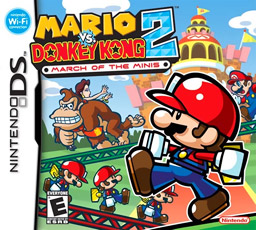
March of the Minis shifts the subseries into a more toy-routing and touch-focused direction, showing how flexible the concept can become.
Nintendo reveals a remake for Switch, framing it as a return to the original rivalry with updated visuals, co-op, and new ways to play.
A free demo arrives before launch, and the full game releases on February 16, 2024 with over 130 levels, new worlds, and local co-op.
The remake has helped reposition Mario vs. Donkey Kong as an important preserved corner of Nintendo’s puzzle-platform history, not just a GBA curiosity.
4NERDS Collector Marketplace
A curated access point for players, collectors, and Nintendo fans: original-market searches, modern Switch copies, related books and accessories, and future handmade display pieces — clearly marked as partner links where applicable.
Shop Mario vs. Donkey Kong copies
Browse current Mario vs. Donkey Kong offers on eBay — useful for Switch physical editions, GBA originals, loose cartridges, boxed copies, manuals, and collector-grade Nintendo finds.
- Switch remake and GBA original searches
- Boxed versions and seller variety
- Condition and price comparison
Paid partner link / Werbung — availability and pricing depend on eBay sellers.
Browse related Nintendo finds
Explore Amazon for Mario vs. Donkey Kong-related items, Nintendo Switch accessories, gaming books, display extras, and broader Mario / Donkey Kong collectibles.
- Books, merch and accessories
- Switch-compatible extras
- Broader Mario and Donkey Kong browsing
Paid partner link / Werbung — as an Amazon Associate, 4NERDS Gaming may earn from qualifying purchases.
Curated Etsy picks coming soon
Planned for handmade retro art, Mini-Mario-inspired display objects, shelf pieces, prints, and museum-style collectibles that match the 4NERDS archive aesthetic.
- Wall art and display-focused pieces
- Handmade and fan-crafted style items
- Added once the setup is ready
Etsy affiliate integration will be added after the tracking setup is approved and tested.
Transparency note: 4NERDS Gaming does not sell these items directly. External shops, prices, stock, shipping terms, and seller conditions may change at any time. eBay and Amazon links in this section are sponsored / paid partner links. Etsy is currently shown as an upcoming integration and does not link out yet.