Exile (1988)
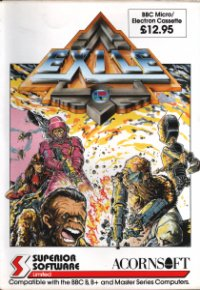
Exile is a 1988 action-adventure set in a huge subterranean alien world. It’s famous for pushing 8-bit hardware with physics-driven movement (gravity, inertia, object mass), a persistent-feeling ecosystem, and nonlinear exploration that many later “Metroidvania” games would echo.
Game Data
| Release Year | 1988 (BBC Micro / Acorn Electron) |
| Developer | Peter Irvin & Jeremy Smith |
| Publisher | Superior Software (original) / Audiogenic (ports) |
| Platform | BBC Micro, Acorn Electron (Ports: C64, Amiga, Atari ST, CD32) |
| Genre | Action-Adventure |
| Players | 1 |
| Original Media | Floppy Disk / Cassette (platform-dependent) |
Gameplay:
Navigate winding caverns using a jetpack, weapons, and tools—while managing energy resources.
Physics matters: blasts, heavy objects, wind shafts, and momentum all influence how you move and solve problems.
Story:
You play Mike Finn, sent to planet Phoebus on a rescue mission after a terraforming team goes silent.
Deep underground, you uncover survivors, hostile creatures, and the renegade Triax (the “Exile”) behind the chaos.
Trivia:
A signature mechanic is the personal teleporter: near death, you’re warped back to safety—keeping exploration tense
without constant hard restarts.
Exile’s design feels shockingly modern: a single massive world, emergent interactions from simple physics rules, and puzzles that come from the environment itself rather than “locked door / key” gating.

Screenshots / Media
Timeline / Versions
Why Exile Was Historically Important
Exile is a standout example of “impossible” ambition on 8-bit machines: a huge, exploration-driven world powered by consistent physics rules (gravity, inertia, mass) that create emergent solutions. It’s frequently cited as an early precursor to the Metroidvania mindset—explore, experiment, learn the system, and push deeper.


