The Research Computer That Made Early Interactive Play Possible
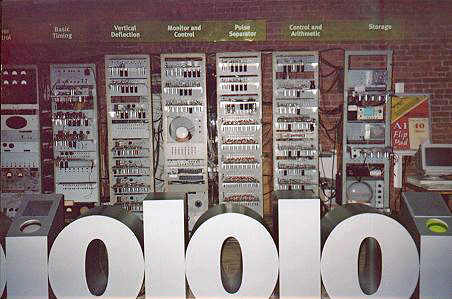
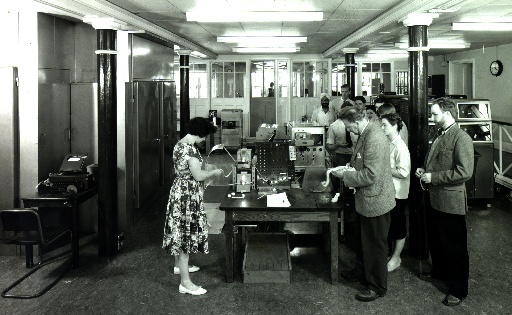
EDSAC belongs to the moment when computing stopped being mostly heroic one-off demonstration and began becoming a real working service. Its purpose was serious: mathematical calculation, scientific research, university work, programming practice, and the building of a practical stored-program culture. But that same practicality is exactly why it matters to game history. OXO could only exist because EDSAC was already a working machine with memory, input, output, displays, users, and a research environment curious enough to test what human-computer interaction could feel like.
Hardware Data / Technical Snapshot
| Name | EDSAC — Electronic Delay Storage Automatic Calculator |
| First Successful Program | 6 May 1949 |
| Location | University of Cambridge Mathematical Laboratory |
| Lead Figure | Maurice Wilkes and the Cambridge team |
| Class | Early practical stored-program electronic computer |
| Technology | Vacuum-tube logic with mercury delay-line memory |
| Initial Memory | 512 17-bit words, later expanded to 1024 words |
| Input | Five-hole punched paper tape |
| Output | Teleprinter output; CRT displays for monitoring memory and machine state |
| Historical Use | Scientific calculation, university research, programming education, service computing |
| Game Connection | Hosted Alexander S. Douglas’s OXO in 1952 |
| Successor | EDSAC 2 |
| Retirement | Late 1950s, after roughly nine years of service |
EDSAC was designed for useful, repeatable computation. Its importance lies in making stored-program computing practical for researchers, not merely spectacular for observers.
It created a working environment where programs could be written, run, reused, studied, and taught — exactly the kind of culture that allowed experiments like OXO to happen.
It was a singular institutional machine. Its breakthroughs were profound, but its direct physical access was limited to a tiny research community.
OXO: The Game That Revealed EDSAC As An Interactive Machine
A small tic-tac-toe program with huge historical meaning
OXO, also known as Noughts and Crosses, was created by Alexander S. Douglas in 1952 as part of his doctoral work on human-computer interaction. The program ran on EDSAC and allowed a player to compete against the computer in a familiar grid game.
The reason OXO deserves its own box on an EDSAC hardware page is simple: the game makes EDSAC’s technical progress visible to a non-specialist. A stored-program machine no longer appears only as a calculator hidden behind punched tape and printouts. It becomes a system that can accept a human move, display a game state, and answer back.
The rotary telephone dial used for input is especially important. It shows that early interaction borrowed from existing everyday hardware long before joysticks, keyboards, mice, and controllers became standard. OXO therefore belongs equally to game history, interface history, and EDSAC’s legacy as a practical research computer.

Research Legacy / Why EDSAC Is Bigger Than A Single Machine
EDSAC’s place in history is not only technological; it is institutional. It helped establish a working culture around computing: writing programs, debugging them, sharing machine time, supporting scientific calculation, and training people to think in stored-program terms. That made it a bridge between the giant experimental machines of the 1940s and the more systematic computer laboratories of the 1950s.
The OXO connection sits naturally inside that legacy. OXO was not an entertainment product that happened to use a computer. It was a human-computer interaction experiment that needed a mature enough machine to make turn-based visual interaction possible. EDSAC gave early play a serious hardware foundation.
What Made EDSAC Feel Like Computing Becoming Real
Many early computers were remarkable because they proved something could be built. EDSAC was remarkable because it could be used. That distinction is central. It became a working research machine at Cambridge, supporting real calculation rather than existing only as a technical trophy.
THE MACHINE AS A UNIVERSITY INSTRUMENTEDSAC’s historical identity is closely tied to academic life. It was not a consumer object, not a commercial office machine, and not a games platform. It was a shared university instrument. In that environment, computing became something people could study, teach, schedule, and apply to scientific questions.
MERCURY DELAY-LINE MEMORY AS A PHYSICAL IDEAOne of the most museum-worthy aspects of EDSAC is its memory. Mercury delay lines stored information through timed pulses, making memory feel almost mechanical and acoustic compared with later semiconductor systems. This gives the machine an unforgettable physical character.
WHY OXO COULD HAPPEN HEREOXO appears because EDSAC had crossed a threshold. It had memory, program control, display hardware that could be repurposed, and an environment where researchers could test how people might communicate with computers. The game was small, but the system behind it was enormous.
A MACHINE WITH A LONG AFTERLIFEEDSAC’s direct physical life ended in the late 1950s, but its afterlife is unusually strong. It survives through documentation, reconstruction projects, computing history, and the stories of programs like OXO. For an archive, that makes it both technical artifact and cultural origin point.
Why Historically Important
EDSAC is historically important because it helped move stored-program computing from theoretical design into dependable service. Its first successful program in 1949 marks one of the key moments where modern computing becomes practical, repeatable, and available to a research community.
It also matters because it hosted OXO in 1952, one of the clearest early examples of visible human-computer interaction through play. That connection makes EDSAC unusually valuable for a gaming hardware archive: the machine is not a console, but it is part of the hardware story that made screen-based computer games thinkable.
For 4NERDS, EDSAC is therefore a deep-origin artifact. It belongs before the arcade, before the home console, before personal computers, and before video games had a market. It shows the scientific and institutional roots from which interactive entertainment eventually grew.
Timeline / Key Milestones
Cambridge’s postwar computing work takes shape under Maurice Wilkes, influenced by the stored-program ideas circulating after EDVAC planning.
EDSAC runs its first successful program, becoming a landmark in practical stored-program computing.
The machine is pressed into use as a research computing service at Cambridge, supporting scientific and mathematical work.
Alexander S. Douglas creates OXO, using EDSAC to display a noughts-and-crosses board and accept player input through a rotary telephone dial.
EDSAC’s memory capability is expanded, strengthening the machine’s usefulness as a working research computer.
The original EDSAC is retired after years of service, with EDSAC 2 continuing Cambridge’s computing lineage.
EDSAC and OXO survive as key heritage objects through museum work, reconstruction projects, emulation, and early-game history.
Why A Hardware Museum Needs EDSAC On Display
Stored-program computing becomes usable
EDSAC shows the moment where modern program-based computing becomes a practical research service rather than only an engineering promise.
ORIGIN VIEWThe hardware behind OXO
OXO makes the machine immediately relevant to early games: EDSAC gave a research program a visible board, input, and computer response.
OXO ANGLERoom-sized computing presence
Racks, tubes, punched tape, delay lines, and CRT displays make EDSAC perfect for explaining how physical early computing really was.
DISPLAY VALUE4NERDS Collector Marketplace
A curated access point for EDSAC, OXO, early computing books, and display-ready archive material
EDSAC itself was a one-off research machine, so this marketplace focuses on related collector searches: early-computing books, OXO / EDSAC references, Cambridge computing history, replica-inspired material, and museum-style display extras.
Search OXO / EDSAC retro-computing items on eBay
Best starting point for out-of-print computing books, retro computer memorabilia, early-game-history material, vintage educational computing items, and collector display pieces.
- Search around OXO, EDSAC, Cambridge computing, early computer games, and stored-program history
- Check book editions, publication years, seller photos, and item condition carefully
- For vintage items, compare provenance, shipping, completeness, and seller ratings
Paid partner link / Werbung — availability, pricing, shipping, and condition depend on individual sellers.
Browse EDSAC and early-computing context on Amazon
Useful for books on early British computing, Maurice Wilkes, stored-program architecture, computer-history timelines, early games, and museum-style archival supplies.
- Good for readable history books and modern overviews
- Useful for display stands, archival sleeves, shelf labels, and presentation material
- Best paired with eBay searches for older, rarer, or out-of-print collector material
Paid partner link / Werbung — Amazon availability and pricing may change at any time.
Curated Etsy picks coming soon
Planned for custom computing-history prints, OXO board art, EDSAC-inspired archive cards, display labels, and handmade museum-style pieces for early-computing shelves.
- Ideal for retro-computing wall art and educational display cards
- Useful for shelf labels, archive tags, and handmade timeline pieces
- Added once the Etsy partner setup is approved and tested
Etsy affiliate integration will be added after tracking setup is approved and tested.
Transparency note: 4NERDS Gaming does not sell these items directly. External shops, prices, stock, shipping terms, and seller conditions may change at any time. The eBay and Amazon links in this section are sponsored / paid partner links. Etsy is currently shown as an upcoming integration and does not link out yet.