The Cabinet That Turned Pong Into Destruction Design
Breakout is one of those arcade machines whose genius becomes more obvious the longer you stare at it. There is almost no excess here. A single paddle protects the bottom of the screen, a ball ricochets upward, and a layered wall of bricks waits to be dismantled piece by piece. That economy gave the game unusual force. It felt readable in seconds, compulsive in minutes, and influential for decades. For arcade history, Breakout is less a sequel to Pong than a mutation: the same hardware-era thinking redirected toward pressure, precision, and collapse.
Hardware Data / Cabinet Snapshot
| Name | Breakout |
| Launch Window | 1976 arcade release |
| Manufacturer | Atari, Inc. |
| Designers | Nolan Bushnell, Steve Bristow |
| Project Lead | Al Alcorn |
| Prototype Engineering | Steve Wozniak with Steve Jobs assisting |
| Production Engineering | Atari production redesign for manufacturable arcade deployment |
| Technology | Discrete logic / TTL hardware, not a microprocessor-based arcade board |
| Display | 19″ vertical raster monitor, black-and-white with colored overlay strips |
| Controls | Analog paddle / rotary control plus serve button |
| Players | 1–2 alternating |
| Audio | Mono arcade sound |
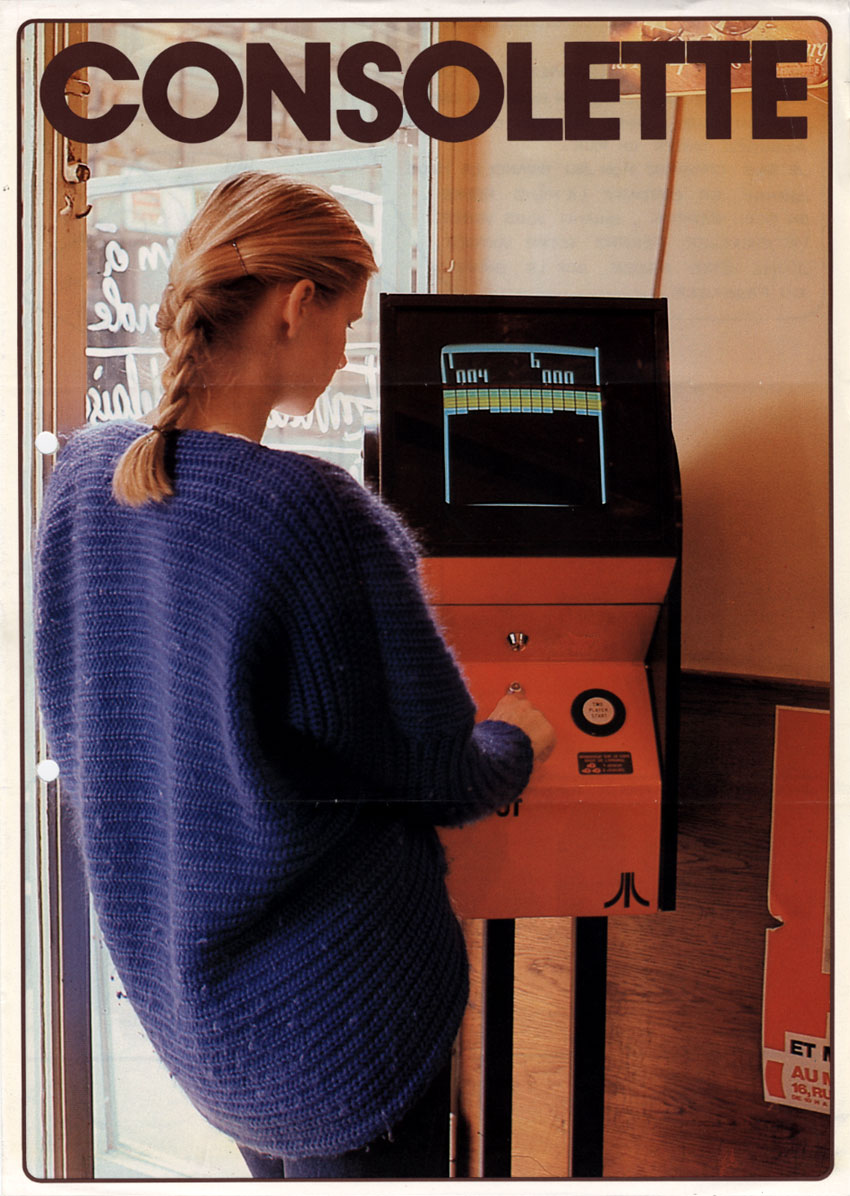
| Cabinet Forms | Upright cabinet, cocktail/table form, and consolette-style presentation |
| Genre | Brick-breaker / single-screen arcade action |
| Legacy | Template for Super Breakout, Arkanoid, and the wider block-breaker family |
Breakout took the familiar rhythm of Pong and redirected it into a one-player assault structure: instead of merely returning the ball, the player had to dismantle the screen itself.
It married mechanical clarity with escalating psychological pressure — shrinking paddle, faster ball, and a wall that visibly eroded under skillful play.
Visually it was austere even for 1976, and its production hardware became less elegant than the famous ultra-minimal Wozniak prototype that inspired it.
Design Legacy / From Pong Mutation To Entire Genre
Breakout matters not only as a single cabinet, but as a design seed. It took Atari’s earlier Pong language — paddle, rebound, timing, wall angles — and turned it into a new dramatic structure based on removal, penetration, and collapse.
That shift proved enormous. Once a wall of targets could be chewed away by repeated impacts, an entire genre became possible. Super Breakout expanded the idea. Arkanoid reinvented it for the 1980s. Endless clones and descendants followed. Breakout is therefore one of those machines whose hardware identity and game-design identity are inseparable.
What Made Breakout More Than “Single-Player Pong”
Atari understood that Pong had not merely created a successful game — it had created a visual and physical language. Breakout emerged from that language, but with a sharper hook: instead of trading rebounds back and forth, the player attacks a structured field of bricks and watches the screen physically open up.
THE JOBS / WOZNIAK LEGENDSteve Jobs, then at Atari, was assigned prototype work on Breakout and brought in Steve Wozniak, whose gift for chip-efficient design was already known inside Atari circles. Wozniak produced an astonishingly compact version of the game logic over an intense short burst of work, giving Breakout one of the most famous engineering side stories in arcade history.
WHY THE PROTOTYPE DID NOT BECOME THE PRODUCTION BOARDThat miracle of reduction came with a cost: the design was too compact and too tricky for straightforward manufacturing. Atari therefore had to rebuild the game for production, expanding the hardware into something more practical for assembly, testing, and support. This tension between brilliance and manufacturability is one of the most important hardware stories inside Breakout.
PURE GAMEPLAY AS CABINET IDENTITYBreakout’s cabinet is unusual because it is visually memorable without being lush. The prison-break artwork gives it metaphor, but the game itself is almost brutally abstract: lines, numbers, a paddle, a ball, and a layered wall. That severity is part of the cabinet’s charm. It looks like a machine built for obsession.
THE OVERLAY ERAThe display was black-and-white, but the game appeared colored through physical overlay strips placed over the monitor. This is one of the details that instantly locks Breakout into its hardware era. It belongs to that moment when cabinet identity was being built partly in electronics and partly in theatrical illusion.
WHY IT HIT SO HARDBreakout feels psychologically stronger than its raw parts suggest. The paddle shrinks, the ball accelerates, the upper field becomes a reward zone, and every clean tunnel through the wall creates its own little crisis of control. It is a masterclass in extracting tension from minimal ingredients.
AFTERLIFEIts success pushed the design into ports, sequels, reinterpretations, and homages. But the original arcade cabinet remains the purest expression of the idea: a hardware-era machine that looks simple, sounds spare, and feels ruthless in motion.
Why Historically Important
Breakout is historically important because it proved how much depth could be extracted from almost nothing. It took the ball-and-paddle grammar of Pong and turned it into a fully new arcade fantasy based on erosion, breach, and mastery.
It is also important as a hardware story. The cabinet sits at the intersection of Atari’s discrete-logic era, the Wozniak/Jobs prototype legend, and the practical engineering reality that transformed a brilliant schematic into a producible commercial machine.
For a museum archive, Breakout is one of the clearest examples of how arcade history was shaped not only by what games players saw, but by what hardware engineers could realistically build, repair, and ship at scale.
Timeline / Key Milestones
Atari develops the idea of converting Pong’s rebound logic into a one-player brick-breaking challenge, with Al Alcorn and Cyan Engineering involved in the broader development process.
Steve Wozniak, brought in through Steve Jobs, produces an extremely chip-efficient prototype that becomes one of the most famous hardware side stories in arcade history.
Breakout launches as an Atari arcade cabinet and quickly establishes itself as one of the company’s major mid-1970s hits.
Cocktail/table and consolette-style presentations expand the machine’s placement possibilities, giving Breakout a broader arcade and public-space footprint.
Breakout becomes one of the defining single-screen arcade attractions of its period, confirming the strength of its stripped-down design.
The game reaches Atari’s home ecosystem and is followed by Super Breakout, formalizing Breakout as a lasting sub-brand rather than a one-off cabinet.
Breakout survives as both a cabinet artifact and a design archetype, permanently embedded in the history of arcade form and game mechanics.
Why A Hardware Museum Needs A Breakout Cabinet
Minimal rules, maximal tension
Breakout shows how little arcade hardware needed to do when the rule set was truly sharp.
DESIGN VIEWPrototype legend built into the board story
Few cabinets tie together Atari, Wozniak, Jobs, and production engineering as cleanly as this one.
HISTORY VIEWThe brick-breaker source point
This cabinet is the hinge between Pong-era rebound play and decades of block-breaking descendants.
LEGACY VIEW4NERDS Collector Marketplace
A curated access point for arcade collectors and Atari history fans: original cabinet searches, PCB and flyer listings, home ports, books, guides, display pieces, and modern related items — clearly marked as partner links where applicable.
Shop Breakout arcade finds
Browse current Breakout arcade offers on eBay — useful for cabinet listings, PCB parts, marquees, control panels, flyers, manuals, Atari-era ephemera, and collector-grade arcade history pieces.
- Original arcade hardware, cabinet parts, flyers, and manuals
- Useful for condition, rarity, region, and price comparison
- Strong route for Atari arcade collectors and preservation finds
Paid partner link / Werbung — availability and pricing depend on eBay sellers.
Browse related Breakout finds
Explore Amazon for Breakout and Atari-related books, arcade history media, retro gaming guides, display accessories, controller-inspired items, and modern collector-friendly extras.
- Arcade history books, Atari books, and retro gaming guides
- Display items, themed accessories, and related collector media
- Useful modern add-ons for an Atari arcade-themed shelf
Paid partner link / Werbung — as an Amazon Associate, 4NERDS Gaming may earn from qualifying purchases.
Curated Etsy picks coming soon
Planned for handmade arcade prints, Atari-inspired wall art, shelf labels, cabinet-room decor, custom retro display pieces, and museum-style collectibles that match the 4NERDS archive aesthetic.
- Wall art and display-focused pieces
- Handmade and fan-crafted arcade style items
- Added once the setup is approved and tested
Etsy affiliate integration will be added after the tracking setup is approved and tested.
Transparency note: 4NERDS Gaming does not sell these items directly. External shops, prices, stock, shipping terms, and seller conditions may change at any time. eBay and Amazon links in this section are sponsored / paid partner links. Etsy is currently shown as an upcoming integration and does not link out yet.