AmidarKonami’s Grid Trap
A deceptively simple arcade maze where every rectangle becomes a promise, every corner becomes a risk, and the whole screen turns into a nervous machine of routes, enemy logic, panic jumps, and perfect early-1980s arcade pressure.
Why this tiny maze still matters
- Pure arcade structure: Amidar builds tension from a fixed lattice, visible goals, and one brutally readable rule set.
- Route commitment: every unfinished rectangle creates pressure because progress only happens when you dare to complete the outline.
- Enemy logic as identity: its famous “Amidar movement” makes pattern reading feel like the central star mechanic.
- Historical weight: it helped define the grid-capture branch of maze games and inspired a long trail of imitators and variants.
“A rectangle becomes a trap the moment you decide to finish it.”
Amidar is not a maze you simply survive — it is a maze you solve while the walls of your own route close in around you.
The Arcade Grid as a Pressure Cooker
Amidar belongs to that brilliant early arcade moment when designers were discovering how much drama could be created from almost nothing: one fixed screen, a few moving threats, and a rule system the player can understand in seconds.
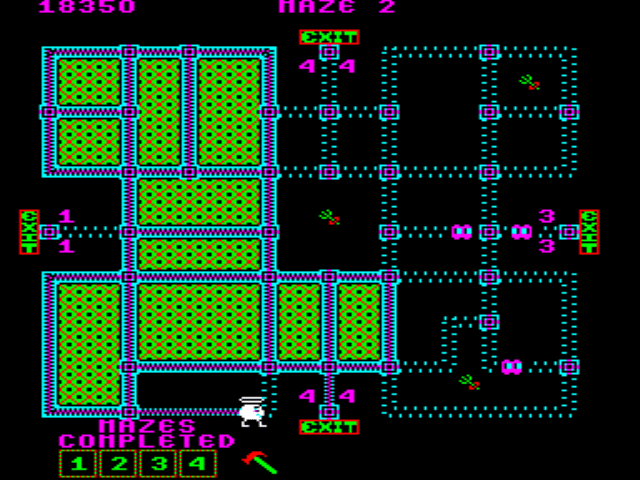
The screen looks harmless at first. You move along a rectilinear lattice, changing lines as you pass. But once you begin outlining rectangles, the board changes psychologically. An unfinished box becomes unfinished business. A nearby enemy turns a straight line into a gamble. A safe route becomes unsafe because you committed to it too late.
At a glanceBest experienced as a clean arcade design study: route planning, territory completion, enemy prediction, limited escapes, and old-school score pressure in one compact machine.
Game Data
| Title | Amidar |
| Arcade Release | 1981 in Japan / October 1981 US listing; often also referenced in the 1982 arcade cycle |
| Developer | Konami |
| Arcade Publisher / Distribution | Konami in Japan; Stern Electronics in North America |
| Home Version Publisher | Parker Brothers for Atari 2600 |
| Known Platforms | Arcade, Atari 2600, Casio PV-1000 |
| Genre | Maze action / grid-capture |
| Players | Single-player; alternating two-player arcade play |
| Controls | 4-way joystick plus jump / emergency escape button |
| Core Loop | Trace lines, complete rectangles, avoid enemies, use jumps sparingly, clear the board |
Gameplay pillars
Fixed-lattice navigation, territory completion, pattern reading, limited emergency jumps, enemy spacing, corner strategy, and escalating speed pressure.
Stage personality
Amidar alternates between gorilla-themed and paint-roller-themed boards, giving the same route-completion structure different visual flavor and scoring texture.
Most famous design fact
The game’s attract text calls attention to “Amidar movement” — a rare early example of enemy movement behavior being presented as a signature feature.
Review / Why Amidar Still Plays So Well
Amidar’s opening seconds are disarmingly direct. You understand the board almost immediately: move along the lines, complete boxes, do not get touched. But clarity is not comfort. As soon as several routes remain half-finished, the grid becomes a map of your own mistakes.
That is the secret. Amidar is not difficult because it hides information. It is difficult because it shows you exactly what you should have done earlier. Every trapped moment feels like the result of a route chosen too greedily, a corner delayed too long, or a jump spent too soon.
Why the movement worksThe enemies are not simply random pressure objects. Their behavior is learnable, and that makes the game more arcade-pure. When you fail, it often feels fair. When you survive, it feels like you read the machine correctly.
Completing a rectangle sounds tiny, but in play it is everything: score, progress, relief, and future safety. The game understands the psychological weight of almost being done. You can see the missing line. You know the path. The danger is that Amidar knows you want it.
Where it shows its ageVisually, Amidar is plainly a product of early arcade hardware. Players who only glance at a screenshot may miss its elegance. But once the route pressure clicks, the simplicity becomes part of the design’s power.
Final verdictAmidar is not the loudest classic in the arcade museum, but it is one of the cleanest. It earns its place through structure: readable rules, hard consequences, and the brilliant idea that drawing a box can feel dangerous.
Why It Matters
Amidar matters because it crystallized a branch of arcade maze design where the player is not merely moving through space, but completing and transforming it. The maze is not a backdrop. It is the scoring system, the risk map, and the shape of progress all at once.
It also captures early Konami at a very interesting stage: before many of the company’s later global franchises, but already showing a gift for tight rules, readable movement, and instantly understandable mechanical hooks.
Its legacy is less about mascot fame and more about design lineage. The grid-capture concept was cloned, reworked, and echoed across arcade and home systems. Not every influential game becomes a household name. Some become a template. Amidar is one of those.
Why it mattered then
It offered a fresh twist on maze action by making perimeter completion and territory control central to survival.
Why it matters now
It remains a clear lesson in how early arcade games built tension from visible rules and constrained space.
What it changed
It helped establish the grid-capture sub-genre and gave later designers a compact idea to imitate and expand.
Timeline / Key Milestones
Amidar appears in Konami’s early arcade cycle, with Japanese references tied to 1981 and US arcade data commonly listing Stern distribution in October 1981.
Stern’s North American cabinet, flyer, marquee, and control-panel materials help give the game its recognizable physical arcade identity.
Parker Brothers brings Amidar to the Atari 2600, translating the trace-and-complete idea into early living-room hardware.
Casio’s PV-1000 version shows how portable the underlying design idea was across modest home systems.
The game’s structure is copied and reinterpreted by numerous later titles, confirming its importance as a practical arcade design template.
Modern retro players can appreciate Amidar as a compact, precise example of early arcade design: visible rules, hard pressure, and no wasted motion.
The grid became the memory — but the Atari box, Parker Brothers cartridge, Stern flyer, cabinet, marquee, control panel, and manuals are the artifacts.
Amidar belongs in the collector lane because its physical material is wonderfully expressive: arcade flyer art full of strange comedy, a bright Stern cabinet, and a Parker Brothers Atari 2600 release that makes the game feel like part of the early home-console boom.
Where to Play / Collect Today
Collecting Amidar means collecting the split between arcade oddity and Atari shelf artifact.
The arcade version is best represented through cabinet material, flyers, marquees and control-panel art. The home side is usually easier to pursue through Parker Brothers Atari 2600 cartridges, manuals and boxed copies. Condition, label quality, completeness, and seller photos matter.
A curated starting point for Amidar collectors: Atari 2600 copies and manuals first, arcade flyers and cabinet parts second, and broader retro-media searches for context pieces.
eBay Collector Search
The strongest route for loose Atari 2600 cartridges, complete-in-box Parker Brothers copies, manuals, original arcade flyers, cabinet parts, marquees, and unusual regional listings.
- Best chance for original physical Amidar items.
- Watch condition, label quality, inserts, and seller photos.
- Useful for both home-console and arcade-paper collecting.
Preserved from the existing Amidar page: eBay search with the 4NERDS campaign parameters.
Amazon Search
Useful for broader retro-gaming books, accessories, preservation media, and occasional third-party listings connected to Atari 2600 collecting and early arcade history.
- Better for context items than rare arcade originals.
- Good for books, storage, display, and retro accessories.
- Use as a secondary route after eBay collector listings.
Preserved from the existing Amidar page. Replace the Amazon tag once the final approved tag is ready.
Etsy Collector Route
Potentially useful later for handmade arcade-room décor, custom cartridge displays, shelf labels, and retro-inspired presentation pieces around Amidar and early arcade history.
- Better suited for display objects than original game media.
- Keep separate from preservation-grade original collecting.
- Ready to activate once the Etsy route is finalized.
Placeholder route kept disabled until a final Etsy affiliate or curated shop strategy is available.